
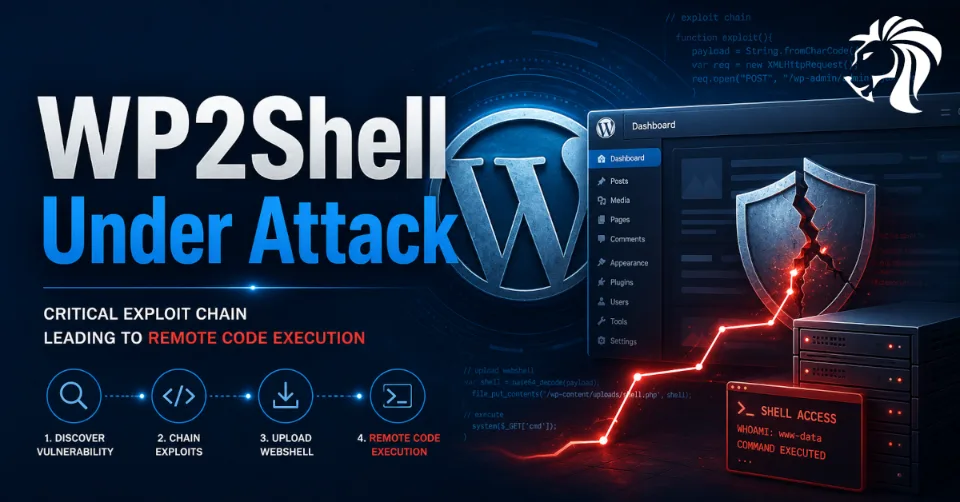
Attackers are widely exploiting two critical WordPress vulnerabilities that can be chained together to achieve unauthenticated remote code execution on vulnerable websites.
The exploit chain, dubbed WP2Shell, combines CVE-2026-60137 and CVE-2026-63030. When used together, the flaws allow an attacker with no login credentials to compromise a default WordPress installation.
Researchers at Searchlight Cyber discovered the vulnerabilities using GPT-5.6 Sol Ultra during vulnerability research. According to the report, AI helped identify the bugs and build the exploit chain in around 10 hours.
The speed of discovery, disclosure, and exploitation shows how quickly AI-assisted vulnerability research can turn into real-world risk.
What Makes WP2Shell Serious
The danger comes from the way the two vulnerabilities work together.
CVE-2026-60137 is an SQL injection vulnerability in WordPress Core. On its own, it requires authentication, meaning an attacker would normally need a valid account to exploit it.
CVE-2026-63030 is a logic flaw in WordPress’s Batch REST API. This API allows applications to bundle multiple requests into a single call.
The flaw involves a mismatch between how the batch endpoint validates requests and how it later executes them. Attackers can abuse this misalignment to pass a malicious request through checks that should normally require login access.
When chained, the Batch REST API flaw makes the SQL injection reachable without authentication.
That changes the impact dramatically.
What begins as an authenticated SQL injection becomes an unauthenticated path to full remote code execution.
Default WordPress Installs Are at Risk
The vulnerabilities affect:
- WordPress 6.9.0 to 6.9.4
- WordPress 7.0.0 to 7.0.1
Because the chain affects default install configurations, the potential exposure is extremely large.
WordPress powers a major portion of the web, and many sites rely on automatic updates or delayed maintenance cycles. That creates a wide target pool for opportunistic attackers.
Security researchers warned that unpatched organizations should assume compromise is possible, especially given the volume of public proof-of-concept exploits and active scanning.
Exploitation Escalated Quickly
The exploitation timeline moved fast.
WordPress released a security update on July 17 to address both vulnerabilities. Due to the severity, the WordPress.org team enabled forced updates through the auto-update system for affected versions.
Within two days of disclosure, researchers had already identified more than two dozen public proof-of-concept exploits targeting WP2Shell.
WatchTowr reported seeing exploitation through its honeypot network shortly after disclosure. Early attacks focused on exfiltrating hashed credentials, but activity quickly expanded to remote code execution as more details became available.
The attacks appear to be broad, automated, and opportunistic.
What Attackers Are Doing After Exploitation
Once attackers gain access, they are not stopping at proof-of-concept validation.
Observed post-exploitation activity includes:
- creating backdoor administrator accounts
- deploying fake WordPress plugins
- exfiltrating credentials and secrets
- uploading additional tooling
- attempting to install remote access malware
- maintaining persistence on compromised sites
WatchTowr reported seeing more than 100 backdoor administrator accounts created by different threat actors using variations of public tooling.
In one observed case, attackers attempted to download Overlord RAT, a Golang-based remote access trojan.
This means defenders should not assume that patching alone is enough if the site was exposed during the exploitation window.
Why AI Changes the Timeline
One of the most important aspects of WP2Shell is the role of AI-assisted vulnerability research.
Searchlight Cyber said GPT-5.6 Sol Ultra helped find the vulnerabilities and develop the exploit chain in a timeframe that would have been extremely difficult for a human researcher working alone.
This matters because attackers can use similar tools once vulnerability details become public.
After disclosure, reproducing exploit chains becomes faster. Public hints, patch diffs, proof-of-concept fragments, and frontier AI models can compress the time between disclosure and mass exploitation.
For defenders, this reduces the old patching cushion.
The window between “patch released” and “Internet-wide exploitation” is shrinking.
Why This Chain Is Attractive to Attackers
WP2Shell is especially dangerous because it skips many steps defenders usually try to detect.
Attackers do not need:
- stolen credentials
- a phished user
- a vulnerable third-party plugin
- admin panel access
- prior foothold on the server
A vulnerable default WordPress installation may be enough.
That makes exploitation easy to automate at Internet scale.
As one expert noted, SQL injection can expose the database, while remote code execution gives control over the server. Together, they create a direct path from anonymous request to full compromise.
What Site Owners Should Do Immediately
WordPress site owners should update immediately to a fixed version.
However, because exploitation began quickly, patching should be treated as only the first step.
Administrators should also inspect sites for signs of compromise, including:
- new or unknown administrator accounts
- suspicious plugins
- recently modified theme or plugin files
- unfamiliar PHP files
- unexpected scheduled tasks
- unknown web shells
- suspicious uploads
- unusual outbound connections
- credential access attempts
- unexpected changes in database users or options
Any exposed site running an affected version should be reviewed, even if it has now been patched.
Recommended Defensive Actions
Organizations managing WordPress environments should:
- verify that all affected WordPress versions are updated
- confirm auto-updates completed successfully
- review administrator users
- remove unknown plugins and themes
- check file integrity against known-good backups
- rotate WordPress administrator passwords
- rotate database credentials if compromise is suspected
- review web server logs for exploit attempts
- restore from clean backups where necessary
- deploy or tune web application firewall rules
- monitor for recurring backdoor creation
- restrict admin access where possible
For managed environments, hosting providers should perform fleet-wide scans and notify customers whose sites show indicators of compromise.
Final Thoughts
WP2Shell is a serious WordPress exploit chain because it combines scale, simplicity, and impact.
The chain affects default WordPress installs, requires no authentication, and can lead to full remote code execution. Public proof-of-concept exploits appeared quickly, and attackers moved from scanning to backdoor creation and malware deployment within a very short window.
The role of AI-assisted vulnerability research adds another lesson.
Defenders now need to assume that once technical details emerge, reproduction and weaponization can happen very quickly.
Patch immediately, but also investigate. If a vulnerable WordPress site was online during the exploitation window, treat it as potentially compromised until proven otherwise.


