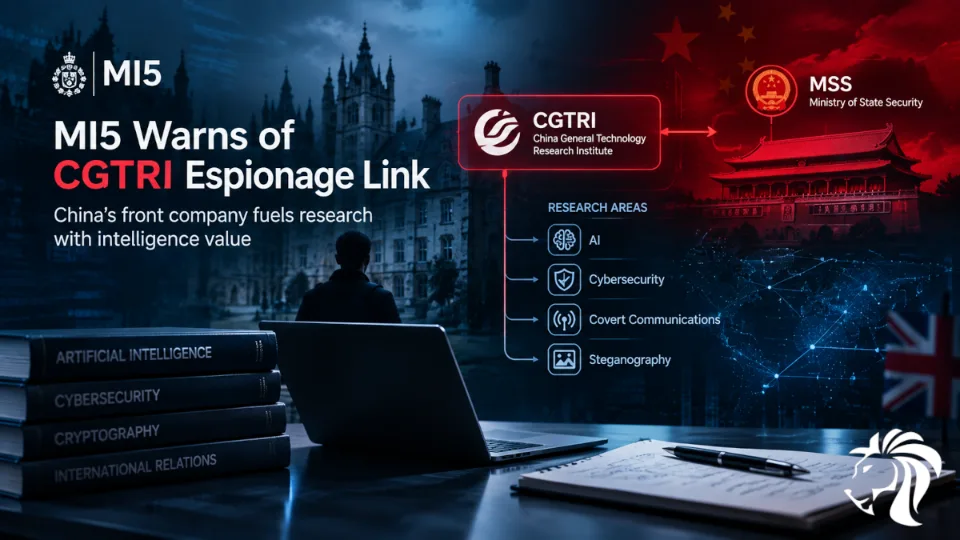
The U.K.’s domestic security service, MI5, has issued an unusually direct public warning about the China General Technology Research Institute (CGTRI), alleging that the research body has strong links to China’s Ministry of State Security (MSS) and has been used to fund research that improves Chinese espionage capabilities.
In an Espionage Alert published on September 30, MI5 said the primary purpose of CGTRI is to fund academic research that directly improves the MSS’s technical capability for espionage. The agency said more than 100 U.K.-linked academics have contributed to projects funded by the MSS through CGTRI.
Importantly, MI5 also said some academics may have been unaware that CGTRI was ultimately funding the research they were contributing to.
Research With an Intelligence Dimension
According to MI5, CGTRI-funded projects have included work involving artificial intelligence, cybersecurity, covert communications systems and steganography.
These areas are particularly significant because they can have clear dual-use applications. Research developed for legitimate academic or commercial purposes can potentially also improve capabilities for intelligence collection, secure communications, information concealment or cyber operations.
MI5's assessment is that CGTRI's role goes beyond conventional academic collaboration and that the research funding ultimately supports MSS espionage capabilities.
The agency's warning highlights a broader security challenge: sensitive research does not necessarily need to be classified to have intelligence value. Emerging technologies, specialist expertise and unpublished research can provide strategic advantages to state actors.
More Than 100 Academics Involved
The scale of the activity is one of the most significant elements of the alert.
MI5 said more than 100 U.K.-linked academics have contributed to CGTRI-funded research. However, the agency also acknowledged that many institutions and researchers may have engaged with the organization in good faith, without understanding its connections to the MSS.
That distinction matters. The alert does not suggest that every researcher involved knowingly supported an intelligence operation. Instead, it demonstrates how opaque funding structures can create a security risk when the ultimate source and purpose of research funding are not fully understood.
Why AI and Cybersecurity Research Matters
AI, cybersecurity and cryptography-related research can provide significant strategic value.
Advanced AI techniques can contribute to automated analysis, pattern recognition and information processing. Cybersecurity research can improve both defensive and offensive capabilities, while cryptographic and covert-communications research can support secure information exchange and concealment.
Steganography — the practice of hiding information within otherwise ordinary files or media — is another example of technology that has legitimate uses but can also be relevant to covert communications.
For universities and companies working on dual-use technologies, the issue is therefore not simply who is paying for research, but also who ultimately benefits from the resulting capability.
MI5 Calls for Immediate Reviews
MI5 has advised U.K. academic institutions to immediately review ongoing and planned collaboration with CGTRI.
The agency is also urging researchers involved in international collaboration to establish the ultimate funding source behind research projects involving Chinese institutions and ensure CGTRI is not involved. MI5 specifically highlighted the need for institutions and researchers to understand their obligations under the National Security Act 2023.
The warning comes alongside broader U.K. efforts to improve research-security controls around sensitive technologies and foreign-state threats.
MI5 has previously warned that foreign states can use academic partnerships, investment and supply chains to obtain sensitive research or technical expertise. Its wider guidance identifies STEM research, dual-use technologies, emerging technology and commercially sensitive information as potential targets for state actors.
China Rejects the Allegations
China's Embassy in London rejected MI5's allegations, describing them as "imaginary and purely fabricated."
The embassy said exchanges and collaboration between U.K. universities and China are voluntary, lawful and mutually beneficial, and accused the U.K. intelligence authorities of undermining academic cooperation.
The claims concerning CGTRI therefore remain an assessment made by MI5 and should be understood in that context.
What Companies and Research Institutions Should Do
The CGTRI case illustrates why research-security controls need to extend beyond traditional cybersecurity defenses.
Companies, universities and research institutions working with external partners should consider:
- Mapping funding chains — identify not only the immediate sponsor but the ultimate source of funding.
- Assessing dual-use research — determine whether research could provide strategic value in AI, cyber operations, cryptography, communications or other sensitive fields.
- Screening external partners — conduct appropriate due diligence on companies, institutes and intermediaries involved in research agreements.
- Protecting unpublished research — apply appropriate access controls to source code, datasets, technical documentation and research results.
- Reviewing information-sharing arrangements — ensure external collaborators receive only the information necessary for the stated research purpose.
- Monitoring ownership and affiliations — reassess relationships when funding structures, corporate ownership or institutional affiliations change.
For companies, the same principle applies to partnerships, contractors and technology suppliers: trust should be established through verifiable ownership, funding and access relationships rather than institutional branding alone.
The Bigger Security Lesson
The CGTRI warning demonstrates how modern espionage can operate through legitimate-looking research and commercial relationships rather than traditional intelligence channels.
For researchers, universities and companies working on advanced technology, the security boundary increasingly includes the research ecosystem itself — funding sources, partnerships, intellectual-property arrangements, data access and the eventual destination of technical knowledge.
The most important lesson is not to treat international collaboration as inherently suspicious. It is to ensure that collaboration involving sensitive or dual-use technology is supported by transparent funding, appropriate due diligence, controlled information sharing and continuous risk assessment.
MI5's warning puts that responsibility into sharper focus: understanding who ultimately funds a research project can be just as important as understanding who directly receives the research.