
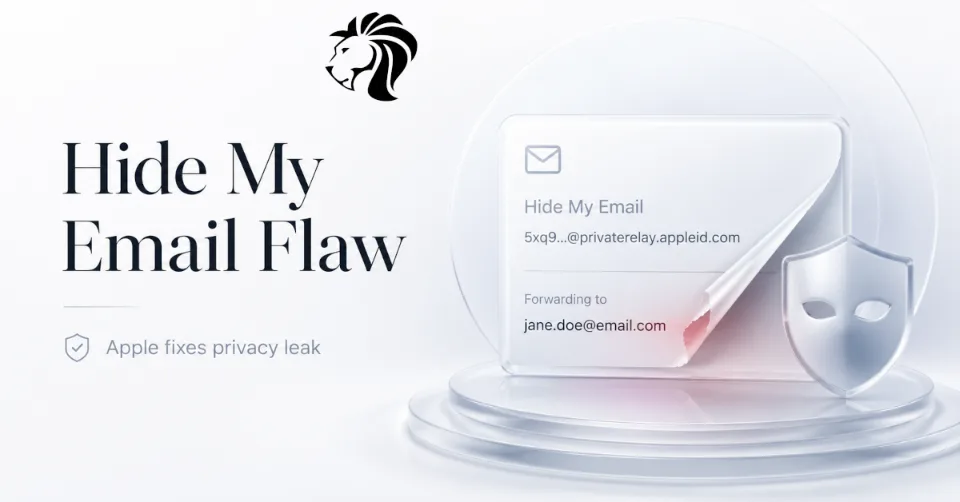
Apple has fixed a privacy flaw in its Hide My Email service that could expose a user’s real email address in certain email delivery logs.
The issue undermined the core purpose of the feature, which is designed to let users create random, disposable email addresses that forward messages to their real inbox while keeping their personal address private.
According to 404 Media, Apple deployed a fix on July 3, 2026, more than a year after the issue was first reported to the company by Tyler Murphy, co-founder of EasyOptOuts.
What Is Hide My Email?
Hide My Email is an Apple privacy feature available through iCloud+.
It allows users to generate unique, random email aliases when signing up for websites, apps, newsletters, or online services.
Messages sent to those aliases are automatically forwarded to the user’s real email inbox.
The idea is simple: users can communicate normally without exposing their actual email address to every company, app, or website they interact with.
This can help reduce spam, limit tracking, and make it easier to disable or discard an alias if it starts receiving unwanted messages.
What Went Wrong
The flaw made it possible for a user’s real email address to appear in email logs when a message sent to a Hide My Email address was rejected as spam.
In practice, this means that if someone sent a message to a Hide My Email alias and that message was automatically bounced or rejected by a mail system, the real destination address behind the alias could be exposed in mail transfer logs.
That is a serious privacy issue.
Users relied on Hide My Email specifically to prevent their real address from being visible to senders, services, or third parties.
The issue was first reported to Apple on June 13, 2025. Apple reportedly attempted to patch it in March 2026 and again on June 30, 2026, before finally resolving it on July 3, 2026.
Why Users May Not Know If They Were Affected
One of the most difficult parts of this issue is that users may have no easy way to know whether their real address was exposed.
According to the researchers, the leak could be triggered when an email was automatically rejected as spam. In many cases, those messages may never have appeared in the user’s inbox or spam folder.
That means users cannot simply review old emails to determine whether their address was leaked.
The exposure may have happened quietly in server-side mail logs controlled by email providers or other infrastructure operators.
ℹ️ What Information Was Exposed
The issue specifically involved the real email address linked behind a Hide My Email alias.
There is no indication from the provided report that this flaw exposed passwords, Apple ID credentials, iCloud data, or message contents.
However, a real email address is still valuable personal information.
Once exposed, it can be used for:
- spam campaigns
- phishing attempts
- identity correlation
- account discovery
- targeted scams
- linking online activity across services
The risk is especially important because Hide My Email users selected the feature specifically to avoid that kind of exposure.
Older Aliases May Still Have Been Logged
Apple has fixed the bug, but the report notes that real email addresses linked to Hide My Email aliases created before July 7, 2026 may already have been captured in mail transfer logs if messages to those aliases were bounced or rejected.
That does not necessarily mean every user was affected.
It means exposure may have occurred under specific delivery conditions, and users may not be able to confirm it directly.
The long reporting and patch timeline also raises questions about how privacy-impacting flaws should be communicated to customers, especially when the affected feature is part of a paid subscription.
Legal Pressure Around the Feature
The fix also comes as Apple faces a class action lawsuit accusing the company of misleading customers about the privacy protections of Hide My Email.
The complaint alleges that Apple promoted the feature as a privacy safeguard while failing to fully deliver on those privacy guarantees.
It also claims that Apple knew about the issue for more than a year and did not warn customers, pause the feature, or update its privacy representations during that period.
These are allegations, and the legal process will determine how they are evaluated.
But the case shows how privacy features are increasingly being treated as security promises, not just convenience tools.
What Users Should Do
Because Apple has deployed a fix, users do not need to disable Hide My Email solely because of this issue.
However, users should treat their real email address as potentially exposed if they used Hide My Email aliases before the fix and are concerned about privacy.
Practical steps include:
- watch for phishing emails sent to the real inbox
- be cautious of messages that appear to know personal account details
- disable aliases that receive suspicious traffic
- use unique passwords for every service
- enable multi-factor authentication where available
- review Apple ID security settings
- consider using separate inboxes for sensitive accounts
Users who rely heavily on Hide My Email for privacy should also review which aliases are active and remove any that are no longer needed.
What Companies Should Learn
This incident is a reminder that privacy features must be tested end to end.
It is not enough for an alias system to hide an address during normal message forwarding. It must also protect that address during errors, spam rejection, bounce handling, logging, and edge-case delivery flows.
Security and privacy teams should pay close attention to:
- mail rejection paths
- bounce messages
- server logs
- forwarding logic
- anti-spam processing
- third-party mail infrastructure
- error handling behavior
- metadata exposure
Privacy can fail in places users never see.
Final Thoughts
Apple’s Hide My Email flaw shows how fragile privacy guarantees can be when edge cases are overlooked.
The feature was designed to keep users’ real email addresses hidden, but a spam rejection path could cause those addresses to appear in email logs.
The bug has now been fixed, but some addresses may already have been exposed in historical mail transfer logs.
Privacy features must protect users not only during normal operation, but also during failures, rejects, bounces, and backend logging.


