
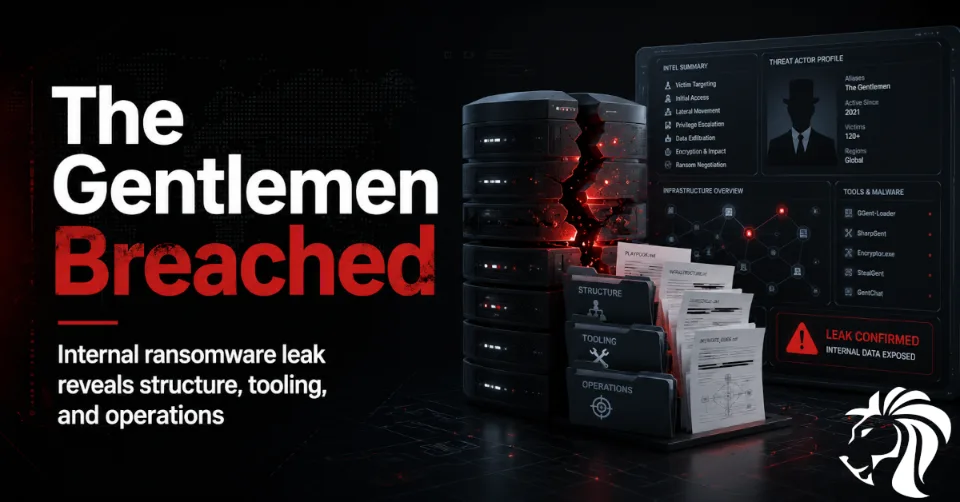
One of the world’s most active ransomware groups has reportedly been breached, exposing a rare glimpse into how a modern ransomware operation is structured, managed, and scaled.
The Russian-speaking cybercriminal group known as The Gentlemen has become one of the most prolific ransomware operations of 2026. In the first five months of the year alone, the gang has published stolen data from around 332 organizations on its leak site. The real victim count is likely higher because ransomware groups usually do not list organizations that pay.
According to Check Point Research, this activity makes The Gentlemen the second most productive ransomware group of the year, behind only Qilin.
But in early May, the group itself became the victim.
An anonymous group reportedly compromised The Gentlemen’s internal backend database and is now offering more than 16GB of internal communications, tooling, and operational data for sale. A smaller leaked sample has already provided researchers with valuable insight into the group’s internal structure, workflows, tooling, and business model.
A Ransomware Group Hit by Its Own Tactics
The breach is a reputational blow for The Gentlemen. Ransomware groups rely on fear, control, and perceived operational security. Being breached undermines that image.
However, researchers do not expect the incident to significantly disrupt the group’s operations. The leaked sample provides insight, but it does not appear to expose a single “magic formula” that would instantly dismantle the gang.
Instead, the leak shows something more practical: The Gentlemen operates less like a chaotic criminal crew and more like a structured business.
That structure may be one of the main reasons behind its rapid rise.
The Leadership: zeta88 at the Center
At the center of The Gentlemen’s operation is an individual known online as zeta88.
According to the analyzed data, zeta88 appears to play several key roles. They build and maintain the ransomware locker, manage infrastructure, oversee tooling, select targets, assign operators, handle negotiations, and manage payouts.
This level of direct involvement matters. Many ransomware-as-a-service operations rely heavily on affiliates, but The Gentlemen appears to have a hands-on central administrator who understands both the technical and operational side of attacks.
Researchers believe this background may have helped the group scale quickly. A leader with affiliate experience understands what operators need, what slows attacks down, and how to build a workflow that keeps the operation productive.
Defined Roles and a Clear Criminal Workflow
The leaked data suggests The Gentlemen has a clear internal division of labor.
Two key operators, known as qbit and quant, appear to support the core operation:
qbit focuses on scanning for vulnerable edge devices, reconnaissance, and establishing persistence in targeted environments.
quant specializes in gaining access through logs and credentials.
Beyond them, the group reportedly includes a smaller support team of red teamers, an access broker, and even an advertising specialist. This suggests a broader ecosystem around the core group, potentially including affiliates or external collaborators.
This structure resembles a corporate workflow:
- target selection
- reconnaissance
- initial access
- persistence
- privilege escalation
- tooling deployment
- ransomware execution
- negotiation
- payment distribution
- leak-site pressure
The criminal nature of the operation does not change the fact that its success appears to come from organization, specialization, and process discipline.
A Generous Payout Model
One of the most interesting findings is the group’s payment model.
According to the leaked sample, zeta88 takes 10% of successful ransom payments, while the remaining operators involved in the attack split the other 90%.
This is a generous split compared with some criminal operations and may help explain why the group can attract and retain capable collaborators.
In ransomware-as-a-service ecosystems, affiliate incentives matter. If operators believe they can earn a larger share while using reliable tooling and infrastructure, they are more likely to participate.
This model also helps the central administrator maintain control without discouraging skilled attackers from joining the operation.
Mature Tooling, but Not Unique
The Gentlemen’s technical toolkit is described as mature, but not especially unique.
The group uses known vulnerabilities and established exploitation techniques to compromise targets. Its supporting toolkit includes almost 30 different tools used for scanning, remote access, persistence, lateral movement, and evasion.
The group also uses techniques designed to bypass endpoint detection and response tools and antivirus products. One example is the bring-your-own-vulnerable-driver tactic, where attackers abuse legitimate but vulnerable drivers to interfere with security controls.
This is a common pattern in modern ransomware operations. Attackers do not always need highly original tools. They often succeed by combining known vulnerabilities, stolen credentials, legitimate remote access tools, defensive evasion techniques, and disciplined execution.
Learning From Other Ransomware Groups
The leak also shows that The Gentlemen watches other ransomware groups closely.
Members reportedly discussed rival or peer groups, sharing opinions and lessons from the broader ransomware ecosystem. They also studied previous leaks from other groups, including Black Basta, with an interest in topics such as code signing.
This is important because cybercriminal groups do not operate in isolation. Techniques, business models, negotiation strategies, tooling decisions, and operational lessons spread across the underground.
When one ransomware group is breached, other groups may study the leak to improve their own operations. Ironically, The Gentlemen appears to have done exactly that with previous ransomware leaks before suffering one of its own.
AI Interest, but Practical Limits
The leaked data also suggests that The Gentlemen has experimented with artificial intelligence.
Members reportedly used large language models to assist with code development and discussed building an in-house LLM-based tool for malicious purposes. However, the group also recognized the limitations of current AI systems.
One comment attributed to zeta88 suggested that even with neural networks, operators still need to understand what they are doing and think carefully because AI tools can be unreliable.
This reflects a broader reality in cybercrime. AI can help attackers write code faster, automate tasks, generate content, and support development, but it does not replace technical understanding. Skilled operators still need to validate, adapt, and control the output.
For now, AI appears to be a productivity enhancer rather than a fully autonomous ransomware operator.
What This Leak Means for Defenders
The breach of The Gentlemen provides defenders with useful intelligence, but it should not be seen as a takedown.
The group’s operations may continue, and the leaked data may not contain enough to fully disrupt its infrastructure or affiliate network. However, the insight into roles, workflows, tooling, and tactics can help security teams better understand how fast-growing ransomware operations function.
Key defensive lessons include:
- ransomware groups are organized and process-driven
- edge devices remain a major target for initial access
- exposed services and unpatched vulnerabilities are high-risk
- stolen credentials and logs can enable compromise
- EDR evasion remains a priority for attackers
- ransomware groups actively study each other’s techniques
- clear internal workflows increase attacker productivity
- strong incident response must assume attackers are coordinated and persistent
Organizations should treat ransomware defense as an operational resilience issue, not just a malware detection problem.
Defensive Priorities for Organizations
To reduce ransomware risk, organizations should focus on the areas most often abused by groups like The Gentlemen:
- patch internet-facing systems quickly
- monitor vulnerable edge devices
- enforce phishing-resistant MFA
- rotate exposed credentials
- restrict remote access tools
- monitor for unusual administrative activity
- detect suspicious driver loading
- review EDR tampering attempts
- segment critical systems
- maintain tested offline backups
- monitor data exfiltration patterns
- prepare ransomware negotiation and incident response playbooks
- conduct regular tabletop exercises
The goal is not only to stop ransomware execution, but to disrupt the entire attack chain before encryption or extortion begins.
Final Thoughts
The breach of The Gentlemen ransomware group offers a rare look behind the curtain of a highly active cybercriminal operation.
The most important lesson is not that the group uses a secret, revolutionary technique. Instead, its success appears to come from structure, specialization, incentives, and disciplined execution.
The Gentlemen operates like a criminal business: clear leadership, defined roles, mature tooling, strong affiliate incentives, and continuous learning from the wider ransomware ecosystem.
For defenders, this means ransomware must be approached with equal discipline. Organizations need visibility, patching, identity security, endpoint protection, backup resilience, and practiced incident response.
The Gentlemen may have suffered a reputational hit, but the ransomware economy remains highly adaptive. Security teams should use the intelligence from incidents like this to strengthen defenses before the next wave of attacks arrives.


