
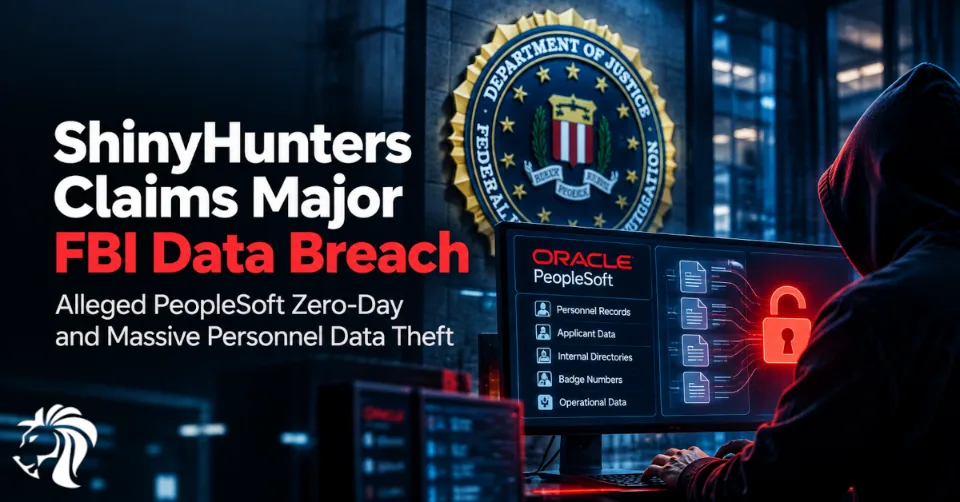
The cyber-extortion group ShinyHunters claims it breached systems associated with the U.S. Federal Bureau of Investigation (FBI) and stole sensitive information belonging to current and former employees as well as FBI job applicants.
The claim emerged on September 22, 2026, when ShinyHunters said it had compromised the FBI and obtained extensive personnel and applicant information. The group attributed the intrusion to an alleged previously unknown Oracle PeopleSoft vulnerability.
However, an important distinction is necessary: the FBI has confirmed that it is investigating unauthorized activity affecting FBIJobs.gov, but it has not confirmed that ShinyHunters breached FBI enterprise systems or that the group's claimed dataset and attack method are genuine.
What ShinyHunters claims
According to statements attributed to ShinyHunters, the attackers gained access through the FBI's employment infrastructure and subsequently reached multiple internal services.
The group claims to have obtained information relating to:
- Current and former FBI employees
- FBI job applicants
- Personnel records
- Contact information
- Internal directories
- Employment-related information
- Badge or identification information
- Other internal operational data
Some reporting has also described claims involving systems referred to as HR, Medlink, Criminal Justice and other FBI services. The group has claimed a dataset measured in terabytes, although the exact size and contents have not been independently established.
These details should currently be treated as attacker claims rather than confirmed facts.
The alleged Oracle PeopleSoft zero-day
ShinyHunters says the initial compromise involved a new vulnerability in Oracle PeopleSoft that allegedly allowed remote code execution without authentication.
No public CVE has been assigned to this alleged zero-day, and neither Oracle nor the FBI has publicly confirmed the existence of the specific vulnerability described by ShinyHunters.
This is particularly important because Oracle did disclose a serious PeopleSoft vulnerability earlier this year.
On June 10, Oracle published a security alert for CVE-2026-35273, affecting PeopleSoft PeopleTools versions 8.61 and 8.62.
Oracle described CVE-2026-35273 as remotely exploitable without authentication and capable of leading to remote code execution. Oracle assigned it a CVSS 3.1 score of 9.8 and issued patches and mitigation guidance.
Security researchers have reported that ShinyHunters exploited this vulnerability earlier in 2026.
But CVE-2026-35273 should not automatically be equated with the newly alleged FBI attack.
ShinyHunters claims the FBI intrusion involved a new PeopleSoft zero-day, while the publicly documented CVE had already been disclosed and patched by Oracle in June. There is currently no public technical evidence proving that the FBI incident used CVE-2026-35273 or a different vulnerability.
What the FBI has confirmed
The FBI has acknowledged unauthorized activity involving FBIJobs.gov and said it is investigating.
In a subsequent statement, the bureau said it was investigating whether the incident involved a third party supporting FBIJobs.gov or the FBI's own enterprise environment.
That distinction is critical.
A compromise of an internet-facing recruitment portal or one of its service providers does not automatically demonstrate compromise of the FBI's broader internal network.
The FBI has also not publicly confirmed:
- The claimed PeopleSoft zero-day
- The alleged 2–3 TB dataset
- Compromise of all FBI employee records
- Compromise of FBI operational systems
- The complete list of affected services
- The precise attack path
- That all data presented by ShinyHunters originated from FBI systems
CBS News reported that journalists examined samples presented as FBI or Justice Department personnel records, with some appearing to correspond to real individuals. However, that does not by itself establish how the records were obtained or prove the full scope claimed by ShinyHunters.
Why the incident matters
Even without confirmation of the full breach claim, the incident highlights a serious security challenge for companies and government agencies using large enterprise platforms.
PeopleSoft is widely used for functions such as:
- Human resources
- Recruitment
- Payroll
- Student administration
- Financial management
A vulnerability in an internet-facing PeopleSoft component can therefore potentially provide access to highly sensitive information.
Oracle's June security alert demonstrates that this is not merely theoretical. CVE-2026-35273 allows unauthenticated network exploitation and can result in takeover of PeopleSoft PeopleTools.
The FBIJobs.gov attack surface
The FBI's recruitment infrastructure is particularly interesting because it is designed to interact with people outside the bureau.
Job applicants may submit:
- Personal information
- Employment history
- Contact details
- Identification information
- Supporting documents
- Other information required during recruitment
This makes recruitment systems attractive targets even when they are completely separated from classified or operational FBI systems.
An attacker does not necessarily need access to sensitive investigative systems to obtain valuable information.
Personnel and applicant data can itself be highly sensitive.
ShinyHunters' stated motive
The group has said the incident was not primarily financially motivated.
Instead, ShinyHunters claims it targeted the FBI in response to a May 2026 FBI warning describing the group's activities and tactics.
The FBI's May warnings discussed ShinyHunters-linked activity involving stolen credentials, cloud and vendor relationships, data theft and extortion. The bureau also warned that actors using the ShinyHunters name could make exaggerated claims and use harassment or other pressure tactics.
ShinyHunters has disputed those descriptions and demanded that the FBI retract or correct elements of its earlier warning.
That makes the current incident particularly unusual: the attackers are publicly presenting the alleged intrusion partly as a response to the agency's previous cybercrime warnings.
A warning about attacker claims
The case also demonstrates why cybersecurity reporting needs to distinguish evidence from attacker statements.
Threat groups have a strong incentive to make dramatic claims about:
- The amount of stolen data
- The number of victims
- The systems they compromised
- Their level of access
- The vulnerabilities they allegedly exploited
Some claims may later prove accurate. Others may be exaggerated or partially incorrect.
In this case, independent reporting has found evidence that some records presented by the attackers correspond to real FBI or Justice Department personnel. That makes the claims worthy of investigation, but it does not yet establish the complete attack narrative.
What companies using PeopleSoft should do
The FBI incident is a useful reminder for companies running PeopleSoft environments to review their exposure regardless of whether the new zero-day claim is ultimately confirmed.
✅ Confirm PeopleSoft versions
Identify all internet-facing PeopleSoft PeopleTools installations and determine whether they run affected versions.
✅ Patch known vulnerabilities
Oracle strongly recommends applying its security updates without delay.
In particular, companies using affected PeopleTools versions should verify that the fixes for CVE-2026-35273 and other relevant PeopleSoft vulnerabilities have been applied.
✅ Reduce internet exposure
PeopleSoft administrative and management interfaces should not be unnecessarily exposed to the public internet.
Where possible, use:
- VPN or ZTNA
- Network segmentation
- Reverse proxies
- Access-control lists
- Strong authentication
- Dedicated administrative networks
✅ Review authentication and application logs
Security teams should look for:
- Unexpected administrative activity
- Unusual PeopleSoft requests
- New accounts or privileges
- Unexpected configuration changes
- Suspicious outbound connections
- Large database queries
- Unusual data exports
- Access from unfamiliar IP addresses
✅ Investigate third-party connections
If a public-facing recruitment or HR platform is operated with the assistance of a third-party provider, review that provider's access and security controls.
The FBI itself has said it is examining the role of third-party providers supporting FBIJobs.gov.
The bigger lesson
The most important lesson from the alleged FBI incident is not necessarily the claimed amount of stolen data.
It is the potential attack path through an enterprise application used for sensitive business processes.
A PeopleSoft system may sit at the intersection of:
Internet → recruitment portal → application server → HR systems → personnel database
If one exposed component is compromised, the attacker may attempt to move deeper into the environment.
This is why enterprise applications should be treated as part of the security perimeter rather than simply as business software.
Final thoughts
The ShinyHunters FBI claim is serious, but the available evidence currently supports a more measured conclusion.
The FBI has confirmed an investigation into unauthorized activity affecting FBIJobs.gov. ShinyHunters claims responsibility and says it used a new Oracle PeopleSoft zero-day to steal extensive personnel and applicant data. The FBI has not confirmed the alleged zero-day, the full dataset, or compromise of its broader enterprise systems.
The incident nevertheless provides a valuable warning for every company operating PeopleSoft or similar enterprise platforms.
Known vulnerabilities need to be patched quickly, internet-facing interfaces need to be minimized, and security teams need visibility across both their own infrastructure and third-party services.
When an enterprise application handles sensitive personnel data, its security must be treated as a critical part of the company's overall security boundary — whether or not an attacker's most dramatic claims ultimately prove true.


