
Data Loss Prevention (DLP) is becoming increasingly important as companies adopt generative AI, AI agents, SaaS platforms and cloud-based workflows. Sensitive information can now move between users, applications and AI systems at a speed that traditional security controls were not designed to handle.
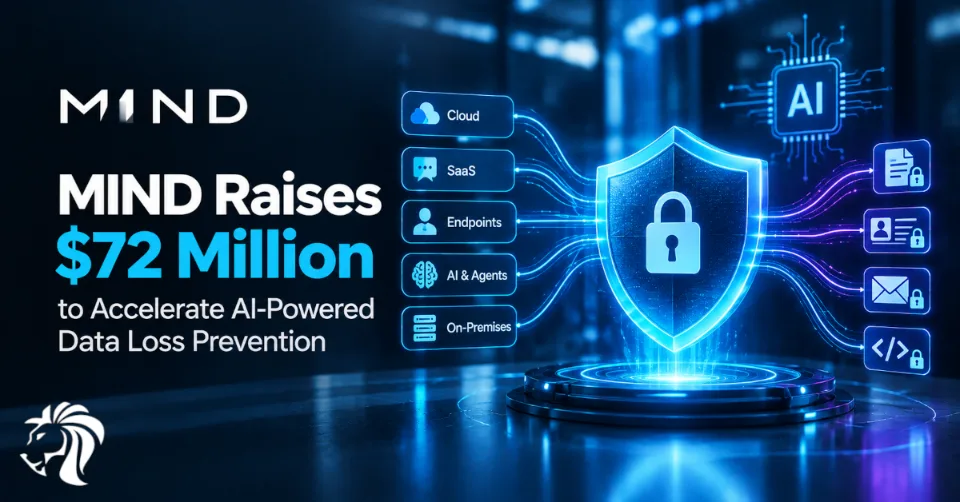
Against this backdrop, MIND, an AI-native data loss prevention company, has announced a $72 million Series B funding round to expand its platform and accelerate its approach to protecting sensitive data in the AI era.
🕵🏻♂️ $72 million Series B brings total funding to $112 million
MIND announced the investment on September 17, 2026. The round was led by Crosspoint Capital Partners, with participation from existing investors YL Ventures and Paladin Capital Group.
The new investment brings MIND's total funding to $112 million, following a $30 million Series A round in 2025.
According to MIND, the funding will support:
- Further development of its AI-native DLP platform
- Expansion into key enterprise markets
- Additional technology and channel partnerships
- Growth of the company's team
- Development of autonomous capabilities for data security
MIND says it has experienced more than 17x revenue growth and 8x customer growth over the past year, while analyzing billions of data events in real time. These figures are company-reported rather than independently audited.
Why traditional DLP is facing a new challenge
Traditional DLP solutions were largely designed around predictable data flows: files, email, endpoints, network shares and established business applications.
AI changes that environment.
Employees can now copy sensitive information into generative AI tools. AI agents can access company files, applications and databases and potentially move information between systems without the same direct human interaction.
This creates new questions for security teams:
- What sensitive information is being sent to AI services?
- Which AI agents can access company data?
- Where is sensitive information being copied or shared?
- Is an unusual data transfer legitimate business activity or potential data loss?
- Can security teams respond quickly enough when the data is moving in real time?
MIND positions its platform around these challenges, combining DLP with insider-risk monitoring and AI-driven automation.
How MIND's platform works
According to the company, its platform is designed to cover the full data-protection lifecycle.
It can:
Discover sensitive data
MIND says it monitors sensitive information across SaaS applications, GenAI and agentic AI environments, endpoints, on-premises file shares and email.
Classify information
Its classification engine uses both the content and context of data to determine its sensitivity.
Detect risky activity
The platform analyzes data activity and attempts to distinguish potentially dangerous behavior from normal business activity.
Respond to exposure
MIND says its system can automate remediation of certain data-security issues, reducing the amount of manual investigation required from security teams.
Prevent data loss
Policy-driven controls can block risky activity in real time or guide users toward correcting the issue.
The company also launched MIND AI DLP Agents in July 2026, designed to automate parts of the day-to-day work involved in operating a DLP program.
The rise of AI agents makes DLP more complicated
The security challenge is no longer limited to employees using ChatGPT-style tools.
AI agents are increasingly being given the ability to retrieve information, interact with applications and perform actions on behalf of users or companies.
That creates another layer of risk.
An AI agent with legitimate access may potentially interact with data differently from a human employee. If permissions are excessive, an agent could have access to information that it does not actually need for its task.
This makes data visibility, classification, access controls and monitoring increasingly important.
The objective is not simply to prevent employees from using AI. Instead, companies need to understand what information is entering AI systems and what AI-enabled workflows can access.
DLP is becoming part of AI governance
The growth of AI is also changing the role of DLP.
Previously, DLP was often associated primarily with compliance and preventing accidental data leakage. In AI-enabled environments, it can become part of a broader AI governance and security strategy.
For example, companies may need policies covering:
- Customer and personal data entering AI tools
- Source code and intellectual property
- Financial and business information
- Confidential documents
- AI agents accessing internal systems
- Data transferred between SaaS applications
- Third-party AI services and integrations
A DLP system that can understand the context of these activities can potentially provide security teams with greater visibility than rules based solely on file types or predefined patterns.
MIND's investment reflects a wider cybersecurity trend
The funding also illustrates a broader shift in cybersecurity investment toward protecting data as AI becomes embedded in business operations.
MIND is not the only company addressing this problem. The wider security market is increasingly focused on protecting AI applications, AI agents, data pipelines and the sensitive information those systems can access.
The difference is that DLP is an established security category. The emerging question is how that category should operate when data can be accessed and moved by autonomous software at machine speed.
MIND's strategy is to make DLP more automated and AI-native rather than simply adding AI features to traditional DLP technology.
What companies should take away
Regardless of which DLP platform a company uses, the underlying security requirements are becoming clearer.
Companies adopting AI should consider:
- Identify sensitive data before allowing AI systems to access it.
- Review AI and agent permissions and apply least privilege.
- Monitor data movement, not just user logins.
- Control unsanctioned AI services and understand where company data is being sent.
- Use classification and context to distinguish legitimate activity from risky transfers.
- Automate response where appropriate, particularly for high-volume data-security events.
- Regularly review third-party AI integrations and the data they can access.
AI adoption without corresponding data-security controls can create visibility gaps that are difficult to detect after sensitive information has already left the company's control.
Final thoughts
The $72 million MIND Series B is another indication that protecting data in AI-enabled environments is becoming a significant cybersecurity priority.
The challenge is not simply stopping traditional data leaks. Companies now need to understand how sensitive information moves through employees, SaaS platforms, AI applications and autonomous AI agents.
As AI becomes more deeply integrated into business processes, DLP will increasingly need to operate at the same speed and scale as the systems it is designed to protect.
AI adoption needs to be matched with equally capable data-security controls.


