
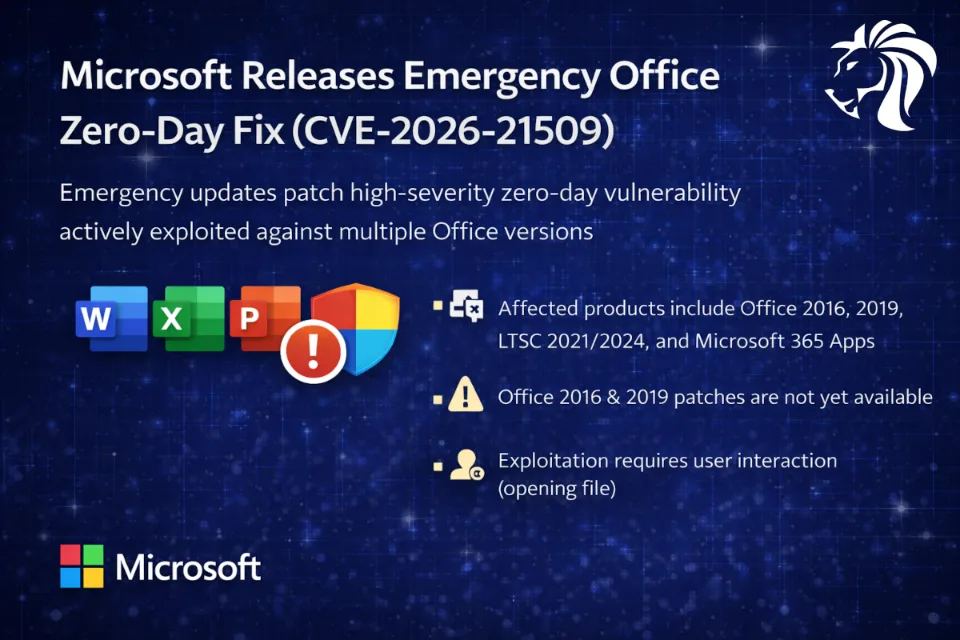
Microsoft has issued out-of-band security updates to address a high-severity zero-day vulnerability in Microsoft Office that is being actively exploited in the wild.
🛑 CVE-2026-21509 allows attackers to bypass Office security features by tricking users into opening a malicious Office document.
Key details:
- Affected products include Office 2016, 2019, LTSC 2021/2024, and Microsoft 365 Apps
- Office 2016 & 2019 patches are not yet available
- Exploitation requires user interaction (opening a malicious file)
- The flaw bypasses OLE security mitigations protecting against unsafe COM objects
What Microsoft says:
- ✅ Office 2021+ users are protected via a service-side update (restart required)
- 🛠️ Temporary registry-based mitigations are recommended for unpatched versions
- 🛡️ Microsoft Defender detections and Protected View help reduce risk
📢 Until all versions are patched, users should:
- Avoid opening Office files from unknown sources
- Never enable editing unless the file is trusted
- Ensure Defender and security updates are enabled
What this means for enterprises
🏢 Immediate exposure risk
Organizations running Office 2016 or 2019 remain partially exposed until official patches are released. This creates a temporary window of vulnerability for targeted phishing campaigns.
📄 User-driven attacks remain effective
The exploit requires user interaction, reinforcing that email-borne Office documents remain a top initial access vector — especially in finance, HR, and executive workflows.
🛡️ Security controls must compensate
Enterprises should ensure:
- Microsoft Defender is fully enabled and updated
- Protected View is enforced via Group Policy
- Registry mitigations are applied where patches are unavailable
🔍 Increased monitoring needed
Security teams should watch for:
- Suspicious Office document execution
- COM/OLE abuse patterns
- Lateral movement following the user document opens
📣 Patch & awareness coordination
This is a strong reminder that patch management and user awareness must move together — technical fixes alone are not enough.


