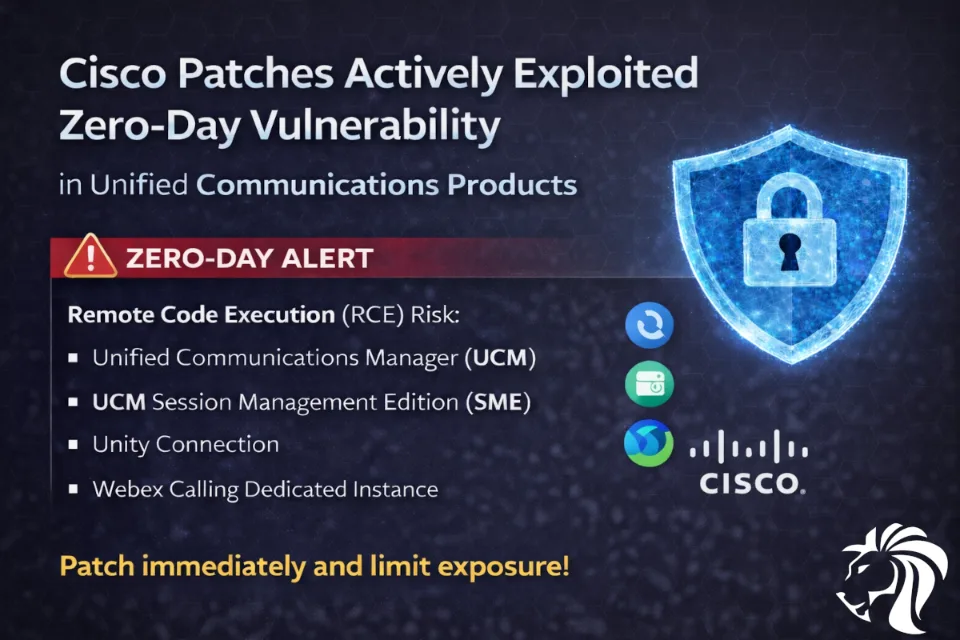
Cisco Patches Actively Exploited Zero-Day in Unified Communications Products

🔍 Cisco has disclosed and patched CVE-2026-20045, a zero-day remote code execution (RCE) vulnerability impacting multiple Cisco Unified Communications products.

Security News 1 min read

Cisco Patches Actively Exploited Zero-Day in Unified Communications Products

🔍 Cisco has disclosed and patched CVE-2026-20045, a zero-day remote code execution (RCE) vulnerability impacting multiple Cisco Unified Communications products.

The flaw affects:

  • Cisco Unified Communications Manager (UCM)
  • UCM Session Management Edition (SME)
  • UCM IM & Presence Service
  • Unity Connection
  • Webex Calling Dedicated Instance

📣 With ~30 million users worldwide, Cisco UCM is deeply embedded in enterprise voice, video, and collaboration environments — making the potential blast radius significant.

⚠️ While public proof-of-concept exploits are not yet available, Arctic Wolf Labs warns that threat actors are likely to aggressively pursue this vulnerability due to the high impact of root-level access. Cisco products have historically been high-value targets and frequently appear in CISA’s Known Exploited Vulnerabilities (KEV) catalog.

This disclosure follows a concerning pattern:

  • ArcaneDoor – state-sponsored espionage campaign abusing Cisco zero-days
  • UAT-9686 (China-nexus) – exploitation of Cisco Secure Email Gateway (CVE-2025-20393, CVSS 10.0)

📌 Why this matters
Unified communications platforms are often:

  • Internet-exposed
  • Highly trusted internally
  • Rarely monitored like traditional servers

👤 That combination makes them ideal initial access points for advanced threat actors.

Organizations running affected Cisco UC components should prioritize patching immediately and review the exposure of management and signaling interfaces.

Blog

Microsoft 5 min read

Keys, Tenants and Trust: two Microsoft cloud incidents that call for action this week

Two Microsoft cloud services were hit in November 2026, and each needs a different response. In Azure API Management (APIM) Classic, attackers exploited a flaw to steal stored secrets, and Norway's security agency says those secrets should be treated as exposed. In Entra Connect Health, attackers accessed tenant metadata and administrator email addresses, but Microsoft says passwords and authentication tokens were not exposed.

Security 5 min read

Ransomware group lists Nvidia on its leak site, but offers no proof

On 18 November 2026, the ransomware group The Gentlemen added Nvidia to its dark web leak site and set a countdown to 28 November. The listing contains no sample files, screenshots or data inventory. Nvidia says it is investigating an incident that may have affected a third-party partner, and that it has found no indication that its own systems or networks were affected. The claim is unverified.

Security 4 min read

Patch Splunk, and retire any internet-facing SonicWall Gen 6 firewall

On 18 November 2026, Splunk patched nearly 140 vulnerabilities in Enterprise, Enterprise Security and SOAR, including several critical flaws, with no active exploitation reported. SonicWall told customers to retire Gen 6 firewalls from the internet edge, as they no longer receive patches for any severity. Patch Splunk and replace Gen 6 devices.