Cyber Attack Targets Polish Power Grid Operations

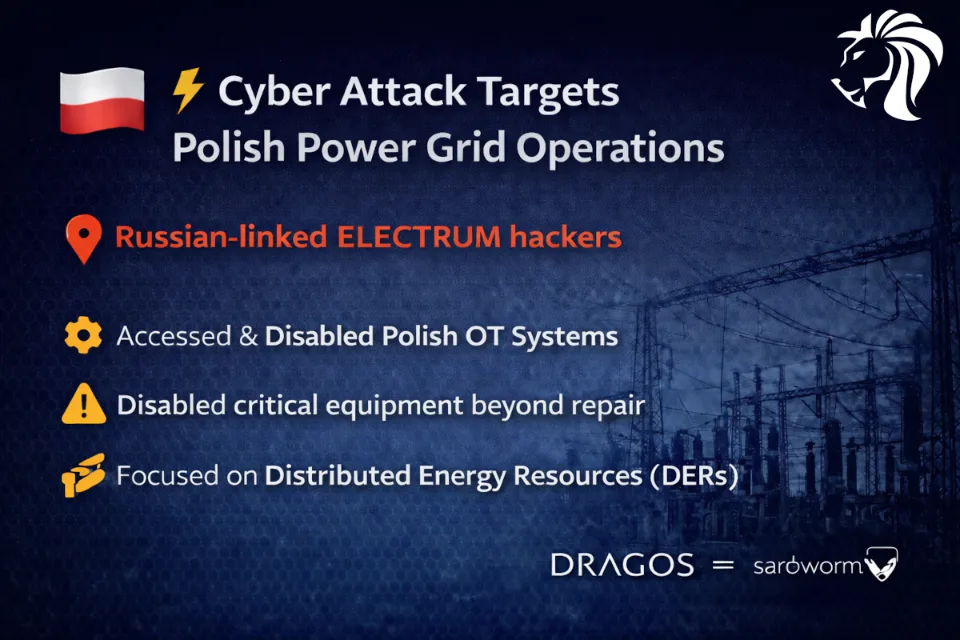
A coordinated cyber attack targeting multiple sites across Poland’s power grid has been attributed with medium confidence to ELECTRUM, a Russian state-sponsored threat group, according to new intelligence from Dragos.

Security News 2 min read

Cyber Attack Targets Polish Power Grid Operations

A coordinated cyber attack targeting multiple sites across Poland’s power grid has been attributed with medium confidence to ELECTRUM, a Russian state-sponsored threat group, according to new intelligence from Dragos.

🔌 The December 2025 incident is described as the first major cyber attack focused on distributed energy resources (DERs).
While no power outages were reported, attackers:

  • ⚙️ Gained access to operational technology (OT) systems
  • 🧱 Disabled critical equipment beyond repair
  • 🌬️ Targeted wind, solar, and CHP facilities
  • 📡 Disrupted communications across ~30 distributed generation sites

Dragos highlights a two-cluster operational model:

  • 🎯 KAMACITE – initial access, reconnaissance, and persistence
  • 🛠️ ELECTRUM – execution within OT networks and ICS-specific actions

🔗 Both clusters share overlaps with Sandworm (APT44 / Seashell Blizzard), reinforcing long-standing state-backed OT tradecraft.

🖥️ Attackers breached Remote Terminal Units (RTUs) and grid communication infrastructure via exposed devices and vulnerabilities, demonstrating a deep understanding of electrical grid operations.

⚠️ In several cases, systems were wiped or reconfigured to impede recovery or permanently brick equipment, escalating the activity from pre-positioning into active disruption.


What this means for enterprises

🚨 No outage ≠ no damage — equipment loss still carries major risk when conditions align

⚡ Distributed energy assets are now frontline OT targets

🌐 IT–OT convergence increases blast radius

🕰️ Pre-positioning can quickly turn into real-world impact

🔐 OT visibility and segmentation are critical, especially for DER communication paths
Blog

Microsoft 5 min read

Keys, Tenants and Trust: two Microsoft cloud incidents that call for action this week

Two Microsoft cloud services were hit in November 2026, and each needs a different response. In Azure API Management (APIM) Classic, attackers exploited a flaw to steal stored secrets, and Norway's security agency says those secrets should be treated as exposed. In Entra Connect Health, attackers accessed tenant metadata and administrator email addresses, but Microsoft says passwords and authentication tokens were not exposed.

Security 5 min read

Ransomware group lists Nvidia on its leak site, but offers no proof

On 18 November 2026, the ransomware group The Gentlemen added Nvidia to its dark web leak site and set a countdown to 28 November. The listing contains no sample files, screenshots or data inventory. Nvidia says it is investigating an incident that may have affected a third-party partner, and that it has found no indication that its own systems or networks were affected. The claim is unverified.

Security 4 min read

Patch Splunk, and retire any internet-facing SonicWall Gen 6 firewall

On 18 November 2026, Splunk patched nearly 140 vulnerabilities in Enterprise, Enterprise Security and SOAR, including several critical flaws, with no active exploitation reported. SonicWall told customers to retire Gen 6 firewalls from the internet edge, as they no longer receive patches for any severity. Patch Splunk and replace Gen 6 devices.