The Gentlemen operates a ransomware-as-a-service business. It supplies malware and infrastructure to affiliates, who carry out intrusions and share proceeds with the operators. According to the ransomware tracking service Ransomware.live, the group has claimed 1,123 victims across 95 countries. Its leak site works as a pressure tool: a group publishes a victim's name, sometimes with samples of stolen data, to push the victim to pay.
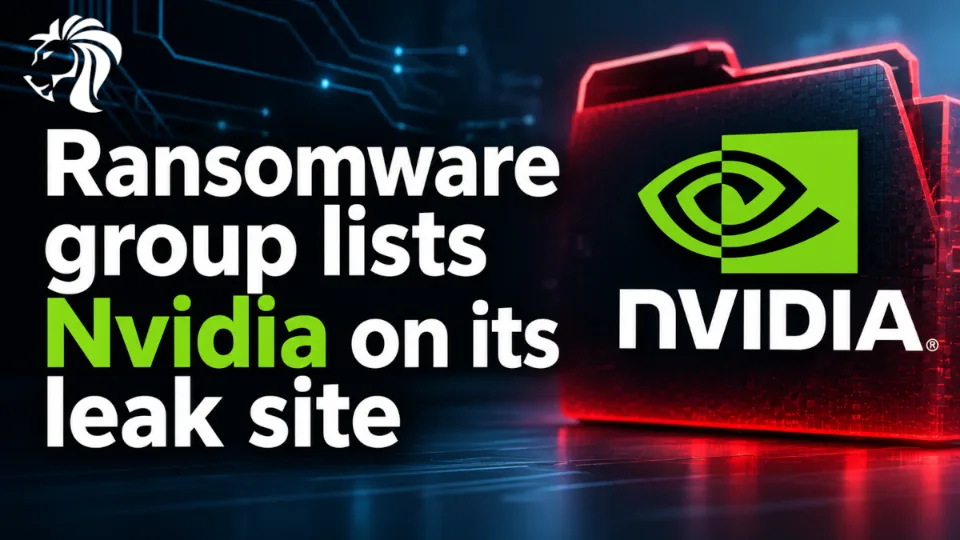
On 18 November, the group listed Nvidia. The listing includes Nvidia's logo, stock ticker and company revenue, with a countdown that initially showed around 238 hours. It does not explain how the attack happened, when it took place or what data was taken. The group says the data is coming soon, and gives a Tox messaging address for negotiation. The countdown points to 28 November 2026.
Nvidia responded through a spokesperson: "NVIDIA is investigating an incident that may have affected a third-party partner. We have found no indication that NVIDIA systems or networks were affected. We continue to monitor the situation."
Date | Event |
|---|---|
18 November 2026 | The Gentlemen lists Nvidia on its leak site with no sample files |
28 November 2026 | Date on the group's countdown, when it says data may be published |
What the claim does not show
The listing does not establish that Nvidia was breached. A leak-site entry is a claim from the attacker, and ransomware groups have an incentive to make claims that look credible. In this case, the listing shows the logo and public financial information, which anyone can find, and no proof of stolen data.
Ransomware trackers classify the Nvidia entry as "pending", which means the claim exists but has not been validated by anyone. Nvidia's statement does not say that nothing happened. It says that its own systems and networks show no sign of being affected and that it is looking into a partner incident. Those are different claims, and both matter.
Nvidia has been in this position before. The company confirmed a data breach in May 2026, when information about some Armenian users of its GeForce NOW service was exposed after a regional partner was hacked. Nvidia said that incident did not affect its own network or its own services. That history shows how partner breaches can reach a large company's customers even when its core systems are untouched.
Why the supplier angle matters
Nvidia's statement puts the focus on a third party. That is a common pattern in modern breaches: a company's own systems may be sound, but its suppliers, resellers, regional partners and service providers hold data about its customers and staff. Attackers often target the weakest link in that chain, because a smaller partner may have less security and still have legitimate access to the larger company's information.
This matters for two reasons. First, if a partner was breached, data about the company's own customers or staff may be involved even though its systems are clean. Second, the company's name can still appear on a leak site, and customers and journalists will ask questions before any facts are known.
What organisations should do
The Nvidia case offers practical lessons for any organisation, not only large technology companies.
Map your third-party data flows. Know which suppliers, partners and service providers hold your customer or staff data, and what they hold. Review this list at least once a year.
Check partner security commitments. Contracts should require prompt breach notification, specify what security controls partners must maintain and give you the right to audit or review them.
Limit the data you share. Supplying a partner with only the data it needs reduces the damage when the partner is compromised.
Prepare a communication plan for leak-site claims. When your name appears on a leak site, you need to respond quickly and accurately. Decide in advance who speaks for the organisation, and what can be said before the facts are known. Nvidia's response, which was brief and factual, is one model.
Do not pay based on a listing alone. Verify claims before any decision. Ask the group for proof and check it against your own logs. Speak to law enforcement and your incident response team before engaging with the group.
Monitor leak sites for your name and your suppliers' names. Early warning gives you time to investigate before a countdown ends.
The lesson
The Gentlemen's listing is a claim, not a confirmed breach. The most useful question for any organisation named on a leak site is what evidence exists, not what the group says. In Nvidia's case, the evidence so far points to a partner rather than the company's own network, but that conclusion may change as the investigation continues.
The wider lesson is about trust. Large organisations depend on many partners, and each partner's security becomes part of their own. Treating suppliers as an extension of the organisation's security is now a basic requirement, not an optional extra.