
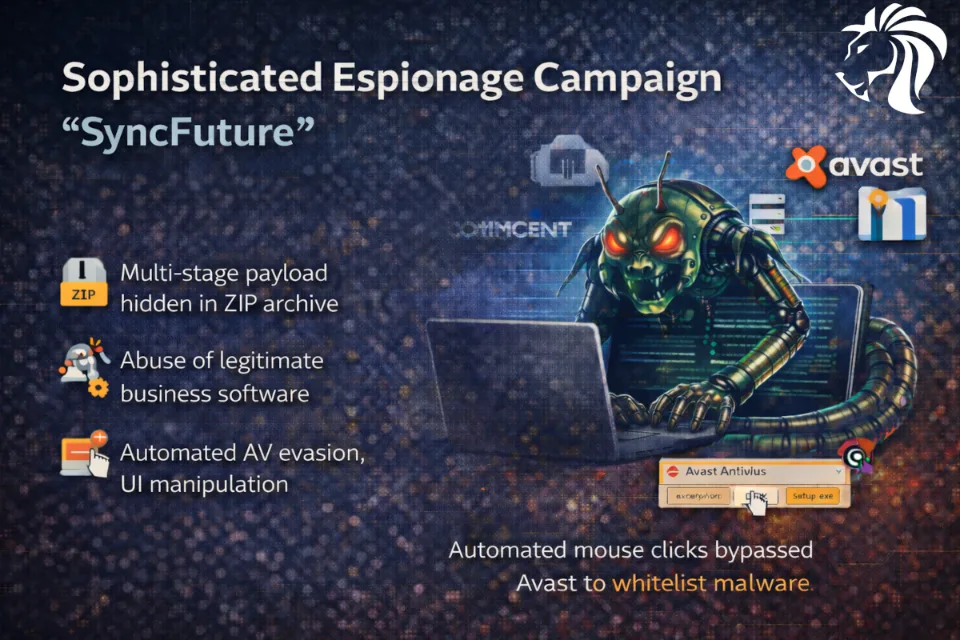
Sophisticated Espionage Campaign Abuses Legitimate Software

Threat researchers uncovered a highly advanced phishing and malware operation dubbed SyncFuture, targeting residents of India through emails impersonating the Income Tax Department.

Security News 1 min read

Sophisticated Espionage Campaign Abuses Legitimate Software

Threat researchers uncovered a highly advanced phishing and malware operation dubbed SyncFuture, targeting residents of India through emails impersonating the Income Tax Department.

Attackers abused legitimate enterprise software, Microsoft-signed binaries, and highly targeted antivirus evasion techniques to gain persistent access to infected systems — including automated UI manipulation of Avast Antivirus to whitelist malware.

This campaign highlights a worrying shift:
➡️ malware no longer just evades security tools — it interacts with them like a human user.

🛡️ A clear signal that modern espionage malware is becoming context-aware, adaptive, and product-specific.

Key Takeaways

📧 Phishing emails impersonating government entities
📦 Multi-stage malware hidden in ZIP archives
🧩 Abuse of Microsoft-signed binaries
🖱️ Automated mouse & click simulation to bypass AV
🔐 Persistence via antivirus exclusion manipulation

⚠️ Why This Matters

Security tools alone are no longer enough.
Defenders must assume attackers understand specific AV products, user interfaces, and enterprise software workflows.

👉 Behavioral detection, endpoint monitoring, and user awareness are now critical.

Blog

Microsoft 5 min read

Keys, Tenants and Trust: two Microsoft cloud incidents that call for action this week

Two Microsoft cloud services were hit in November 2026, and each needs a different response. In Azure API Management (APIM) Classic, attackers exploited a flaw to steal stored secrets, and Norway's security agency says those secrets should be treated as exposed. In Entra Connect Health, attackers accessed tenant metadata and administrator email addresses, but Microsoft says passwords and authentication tokens were not exposed.

Security 5 min read

Ransomware group lists Nvidia on its leak site, but offers no proof

On 18 November 2026, the ransomware group The Gentlemen added Nvidia to its dark web leak site and set a countdown to 28 November. The listing contains no sample files, screenshots or data inventory. Nvidia says it is investigating an incident that may have affected a third-party partner, and that it has found no indication that its own systems or networks were affected. The claim is unverified.

Security 4 min read

Patch Splunk, and retire any internet-facing SonicWall Gen 6 firewall

On 18 November 2026, Splunk patched nearly 140 vulnerabilities in Enterprise, Enterprise Security and SOAR, including several critical flaws, with no active exploitation reported. SonicWall told customers to retire Gen 6 firewalls from the internet edge, as they no longer receive patches for any severity. Patch Splunk and replace Gen 6 devices.

