
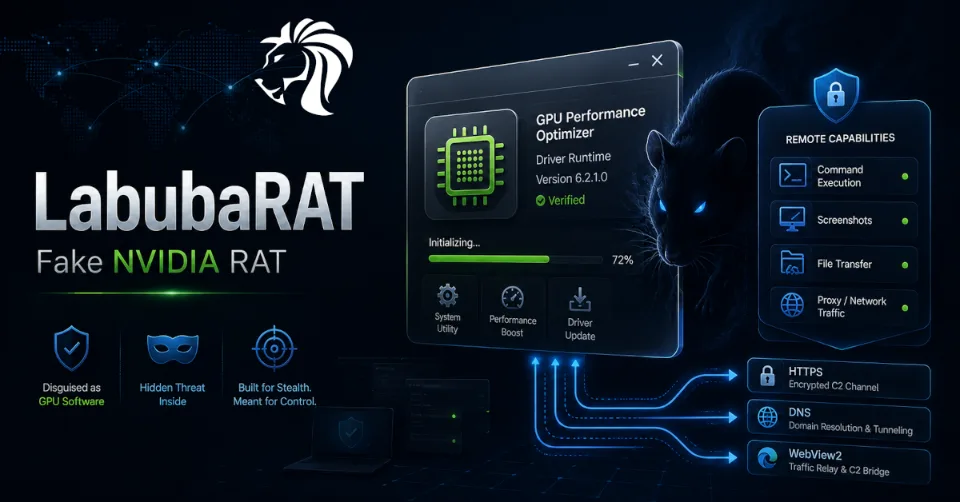
Cybersecurity researchers have identified a previously undocumented Rust-based remote access trojan known as LabubaRAT, which disguises itself as NVIDIA-related software to blend into Windows environments.
According to Blackpoint Cyber, the malware is designed to give attackers a reusable foothold on compromised systems. Once deployed, it can profile the host, identify security tools, execute commands, move files, capture screenshots, and route traffic through the infected machine.
The implant’s structure suggests it was built as a flexible remote access framework rather than a one-off malware sample.
How the Attack Starts
The observed attack chain begins with an executable named:
nvidia-sysruntime.exe
The filename is designed to impersonate NVIDIA’s container runtime toolkit, making the malware appear less suspicious in environments where NVIDIA software or GPU-related tools may be expected.
Rather than hard-coding its command-and-control details inside the binary, LabubaRAT receives its configuration at runtime through command-line arguments.
This allows the operator to define key settings such as:
- C2 server details
- polling interval
- campaign-specific parameters
- encoded configuration values
The same compiled malware can therefore be reused across different targets or campaigns simply by changing the launch configuration.
That makes the tool more adaptable and harder to track based only on static indicators.
Configuration Stored Locally
After launch, LabubaRAT stores its configuration in a local SQLite database.
This gives the malware local state and persistence of its operating parameters. It also supports a more organized agent-style model, where each infected host can be enrolled, profiled, and managed over time.
This design is one of the signs that LabubaRAT is more than a simple backdoor.
It behaves like a configurable remote access platform.
Host Profiling and Security Tool Discovery
One of LabubaRAT’s first actions is to profile the infected system.
It collects information such as:
- hostname
- RAM size
- CPU model
- Windows User Account Control state
- installed browsers
- installed security products
The malware checks for common browsers including Chrome, Firefox, Edge, and Brave.
It also looks for security tools such as Microsoft Defender, CrowdStrike, SentinelOne, Carbon Black, Sophos, Malwarebytes, Bitdefender, ESET, Kaspersky, McAfee, Symantec, and Trend Micro.
This kind of profiling helps the operator understand the environment before taking further action.
It may also influence which functions are used, how aggressively the attacker proceeds, or whether additional tooling is deployed.
Multiple Communication Channels
A notable feature of LabubaRAT is its support for multiple communication methods.
The implant can communicate using:
- HTTPS
- WebView2
- DNS tunneling
This gives attackers fallback options.
If defenders detect and block one channel, the malware may still have another way to communicate with its operator.
DNS tunneling is especially concerning because DNS traffic is often allowed by default and may not receive the same level of inspection as direct HTTP or HTTPS traffic.
Multiple communication paths make containment and detection more difficult.
What LabubaRAT Can Do
Once active, LabubaRAT provides a broad set of remote access capabilities.
Its functions include:
- command execution
- PowerShell execution
- JavaScript execution
- screenshot capture
- file upload
- file download
- archive handling
- SOCKS5 proxy support
These capabilities allow an operator to interact with the host, move data in and out of the environment, route traffic through the compromised system, and maintain access without needing a separate loader or additional tool.
The SOCKS5 proxy functionality is particularly important because it can allow attackers to use the infected machine as a relay point for further activity.
Why Rust Matters
LabubaRAT is written in Rust, a language increasingly seen in modern malware development.
Rust offers performance, cross-platform potential, and memory-safety benefits for legitimate developers. But threat actors also value it because Rust binaries can complicate analysis and detection workflows.
Security teams are seeing more malware families adopt languages such as Rust and Go because they can help attackers build portable, resilient tooling.
In LabubaRAT’s case, Rust appears to support a framework-like design that can be configured and reused across multiple deployments.
Possible Malware-as-a-Service Signals
Researchers noted signs that LabubaRAT may be connected to a malware-as-a-service model.
The name appears to come from LabubaPanel, a title associated with the command-and-control infrastructure, along with a Labubu-themed favicon.
This branding suggests the tool may have a panel-driven operational model, where operators manage infected hosts through a centralized interface.
While attribution remains unclear, the structure points to a reusable ecosystem rather than a single isolated campaign.
Why This Threat Matters
LabubaRAT is concerning because it combines several useful attacker capabilities into one package.
It can:
- impersonate legitimate software
- accept runtime configuration
- profile the environment
- detect security tools
- use multiple communication channels
- execute operator commands
- move files
- capture screenshots
- proxy traffic
- maintain user-level autostart
That gives attackers a practical foothold for hands-on activity.
It also means defenders need to look beyond the filename. A process that appears to be NVIDIA-related may not be legitimate if its location, behavior, command-line arguments, or network activity do not match expected software behavior.
What Defenders Should Watch For
Security teams should investigate suspicious activity involving unexpected NVIDIA-themed binaries, especially if they appear outside normal installation paths.
Useful detection areas include:
- unusual execution of
nvidia-sysruntime.exe - suspicious command-line arguments or Base64-encoded launch parameters
- unexpected SQLite database creation by unknown binaries
- browser and security-tool enumeration behavior
- abnormal WebView2 usage
- DNS tunneling indicators
- unusual HTTPS polling
- SOCKS5 proxy behavior
- screenshot capture from non-standard processes
- unexpected PowerShell or JavaScript execution chains
Defenders should also baseline legitimate NVIDIA software locations and expected process behavior so impersonation attempts are easier to spot.
Final Thoughts
LabubaRAT shows how modern remote access malware is becoming more modular, configurable, and resilient.
Its use of Rust, runtime configuration, local state, host profiling, multiple communication channels, and operator tasking gives attackers a flexible platform for maintaining access and conducting hands-on activity.
The NVIDIA disguise is only the surface-level trick.
The deeper concern is the framework-like structure behind the malware: a reusable RAT built to enroll hosts, understand their environment, receive commands, move files, capture screenshots, and proxy traffic through compromised systems.
Trusted-looking filenames are not enough. Behavior, execution context, command-line activity, and network communication remain critical to detecting modern RAT operations.


