
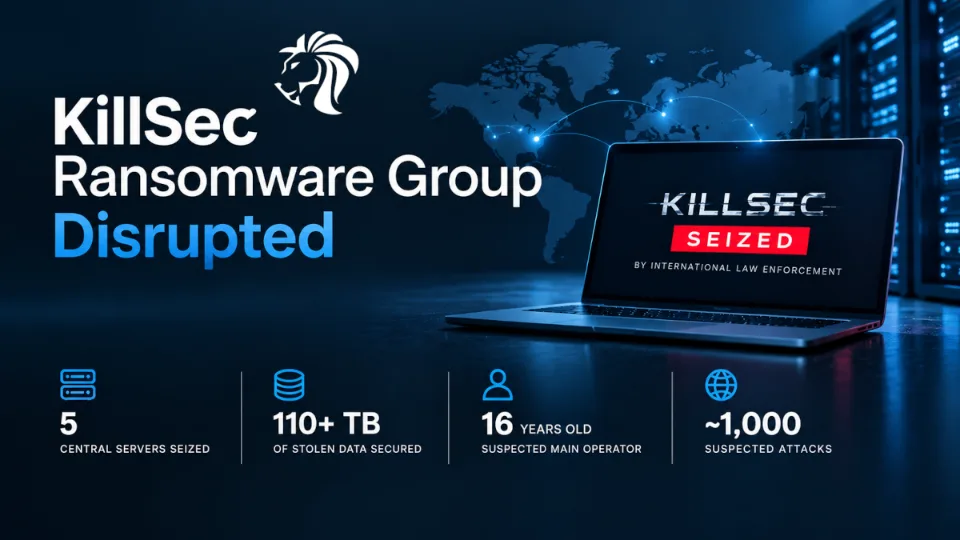
An international law-enforcement operation has disrupted the KillSec ransomware-as-a-service (RaaS) group, taking control of its leak site, seizing core infrastructure and securing at least 110 terabytes of stolen data.
The operation, known as Operation KillSwitch, involved authorities from Europe and the United States and resulted in three provisional arrests and searches at eight properties across Greece, Romania, Spain and the United Kingdom.
Investigators also identified a 16-year-old as the suspected main operator and administrator of KillSec, highlighting the increasingly distributed and accessible nature of the ransomware-as-a-service ecosystem.
What happened to KillSec?
On 30 September 2026, law-enforcement authorities took control of KillSec's dark-web leak site.
The ransomware group used the site as part of its double-extortion operation: it stole victims' data and threatened to publish it unless a ransom was paid.
After the seizure, law enforcement placed the infrastructure under its control, preventing KillSec from continuing to use its leak site to pressure victims.
Authorities also seized five central servers used by the group to manage its activities and store stolen information. KillSec's domains were redirected to a law-enforcement seizure notice.
The operation was coordinated internationally through Europol and Eurojust, with authorities from Belgium, Finland, Germany, Greece, Romania, Spain, Switzerland, the United Kingdom and the United States participating in the investigation.
More than 110 TB of stolen data secured
One of the most significant aspects of the operation was the amount of victim data brought under police control.
Authorities secured at least 110 TB of stolen data from KillSec's infrastructure, preventing further unauthorized access to the material while investigators examine the seized systems and information.
The data may also provide investigators with evidence that can help identify additional victims, previously unknown attacks and other individuals involved in the ransomware operation.
This is particularly important because ransomware groups often maintain extensive victim information even after an attack has ended.
The seizure therefore serves two purposes: disrupting the criminal operation and preserving evidence for the wider investigation.
KillSec was linked to almost 1,000 suspected attacks
According to Eurojust, investigators linked KillSec to almost 1,000 attacks worldwide.
However, the investigation has so far identified approximately 500 successful attacks, a figure that may change as authorities analyze the seized devices and data.
KillSec has been active since around 2024 and operated as a ransomware-as-a-service group.
Rather than conducting every intrusion itself, the RaaS model allows different participants to perform different roles. Affiliates can conduct compromises using the group's infrastructure and ransomware tooling, while other members handle administration, development, negotiation and other operational functions.
Investigators identified suspected individuals occupying several of these roles, including an administrator, developer, negotiator and affiliate.
A teenager is suspected of being the main operator
Perhaps the most unusual element of Operation KillSwitch is the age of the individual investigators identified as KillSec's suspected main operator.
Europol says a 16-year-old was identified as the group's suspected administrator and main operator.
Authorities have not publicly released the teenager's identity. The description remains an investigative allegation rather than a judicial finding.
Investigators also identified a suspected developer who turned 18 in August and who was allegedly a minor when some of the offenses occurred.
The investigation demonstrates how ransomware operations can bring together individuals with different technical and criminal roles, even when some participants are very young.
It also illustrates the importance of looking beyond the infrastructure itself. Seizing servers can disrupt a ransomware operation, but identifying the people responsible for administering, developing and operating the service can provide a much longer-term disruption.
How KillSec operated
KillSec followed a familiar double-extortion model.
The group gained unauthorized access to organizations, stole sensitive information and then threatened victims with publication.
Eurojust reports that KillSec particularly exploited poorly secured access points, including those associated with cloud storage.
Once inside a victim environment, attackers copied data to infrastructure controlled by the group. Victims then received demands for payment.
If organizations refused to pay, KillSec could publish the stolen information or make it available for download through its leak infrastructure.
This model increases pressure on victims because restoring systems alone does not resolve the incident. Even after an organization recovers from encryption or intrusion, the attacker can continue threatening disclosure of sensitive information.
Why the leak-site seizure matters
The leak site was more than a website.
For a ransomware group, it is part of the extortion infrastructure.
The site gives attackers a public mechanism to:
- Name victims
- Publish stolen information
- Demonstrate possession of data
- Pressure organizations into paying
- Attract attention from potential affiliates
- Maintain credibility within the cybercrime ecosystem
Taking control of the site therefore removes an important component of the group's business model.
At the same time, the seizure does not automatically mean that every copy of stolen data has disappeared. Investigators have secured the data held on the infrastructure they control, while additional copies could potentially exist elsewhere.
For affected companies, the takedown should therefore be viewed as a significant law-enforcement disruption rather than proof that all previously stolen information has been permanently destroyed.
The importance of the seized servers
Five central servers were brought under police control during the investigation.
These systems were reportedly used to manage KillSec's activities and store information taken from victims.
From an investigative perspective, this infrastructure could be extremely valuable.
Ransomware operations leave behind more than encrypted files. Their backend systems can contain:
- Victim information
- Attack records
- Negotiation history
- Affiliate information
- Authentication data
- Cryptocurrency-related evidence
- Infrastructure details
- Malware and tooling
- Communications
- Stolen files
Examining this information could allow investigators to connect attacks that were previously attributed to different actors or identify additional participants.
Europol says investigators will continue examining the seized devices and data while tracing the group's financial proceeds.
KillSec and the ransomware-as-a-service model
KillSec is also an example of why ransomware should not be viewed simply as malware.
Modern ransomware operations increasingly resemble criminal service ecosystems.
Different participants can specialize in:
Initial access → intrusion → data theft → encryption → negotiation → extortion
The RaaS operator can provide the platform and infrastructure while affiliates carry out individual attacks.
This model allows criminal groups to scale without requiring every participant to possess the same technical capabilities.
Group-IB identified KillSec as a financially motivated RaaS operation and reported that the group recruited affiliates through its underground infrastructure. The company also observed KillSec among the more active ransomware groups in several regions during 2025.
What happens next?
The takedown is unlikely to be the end of the investigation.
Authorities are now analyzing the seized systems and data to identify additional victims, attacks and suspects.
The investigation is also following the group's financial activity, including cryptocurrency transactions.
For previously affected companies, the seized data could potentially provide useful information about what was stolen and how the attackers operated.
Organizations that suspect they were targeted by KillSec should therefore continue working with their incident-response teams and relevant authorities rather than assuming that the infrastructure seizure closes the incident.
What companies can learn from the KillSec operation
The disruption provides several practical lessons for companies defending against ransomware.
✅ Protect externally exposed systems
KillSec reportedly exploited poorly secured access points and cloud-related exposure.
Companies should maintain an accurate inventory of internet-facing assets and continuously assess them for vulnerabilities, exposed services and configuration weaknesses.
✅ Strengthen cloud security
Cloud storage and identity infrastructure remain attractive targets.
Companies should enforce strong authentication, least privilege, conditional access and appropriate monitoring across cloud environments.
✅ Detect data theft before encryption
Ransomware defense should not focus exclusively on encryption activity.
Data theft frequently occurs before ransomware deployment.
Monitoring unusual archive creation, large outbound transfers, unexpected cloud-storage access and abnormal administrative activity can help identify an intrusion earlier in the attack chain.
✅ Maintain offline or isolated backups
Reliable backups remain an important recovery control.
Critical backups should be protected from unauthorized modification and separated sufficiently from production systems to prevent attackers from compromising both the primary environment and recovery infrastructure.
✅ Prepare for double extortion
A company may be able to recover its systems without recovering control over stolen information.
Incident-response plans should therefore address both system recovery and data-exposure scenarios, including legal, regulatory, communications and customer-notification requirements where applicable.
✅ Monitor ransomware intelligence
Law-enforcement takedowns can generate valuable intelligence.
Companies should monitor official seizure announcements and threat-intelligence reporting for information about affected infrastructure, victim organizations, attack methods and recovered data.
The broader significance of Operation KillSwitch
Operation KillSwitch demonstrates why international cooperation remains important in the fight against ransomware.
KillSec's infrastructure, suspected operators and affiliates crossed national boundaries. No single jurisdiction necessarily had access to the entire picture.
The investigation brought together authorities across Europe and the United States, supported by Europol, Eurojust and private-sector cybersecurity specialists.
The result was not simply the removal of a website.
Authorities gained control of servers, preserved stolen data as evidence, identified suspected members and disrupted a ransomware operation linked to hundreds of successful attacks.
The case also highlights a continuing challenge for the cybersecurity industry: ransomware capabilities are increasingly accessible, and sophisticated criminal operations can be assembled from relatively small groups of technically capable individuals.
Final thoughts
The KillSec takedown is a significant disruption to a ransomware operation that investigators link to almost 1,000 suspected attacks worldwide.
The seizure of the group's leak site and five central servers, combined with the securing of at least 110 TB of stolen data, allows authorities not only to disrupt the group's extortion activities but also to uncover additional victims, infrastructure and participants.
The identification of a 16-year-old as the suspected main operator adds another dimension to the case, demonstrating how the ransomware ecosystem can draw technically capable individuals into organized cybercrime at a very young age.
Ransomware resilience depends on reducing exposed attack surfaces, securing cloud and identity infrastructure, detecting data theft early, maintaining resilient backups and preparing for extortion even when systems can be restored.
Operation KillSwitch may have removed a major piece of KillSec's infrastructure, but the broader ransomware-as-a-service economy remains active.


