
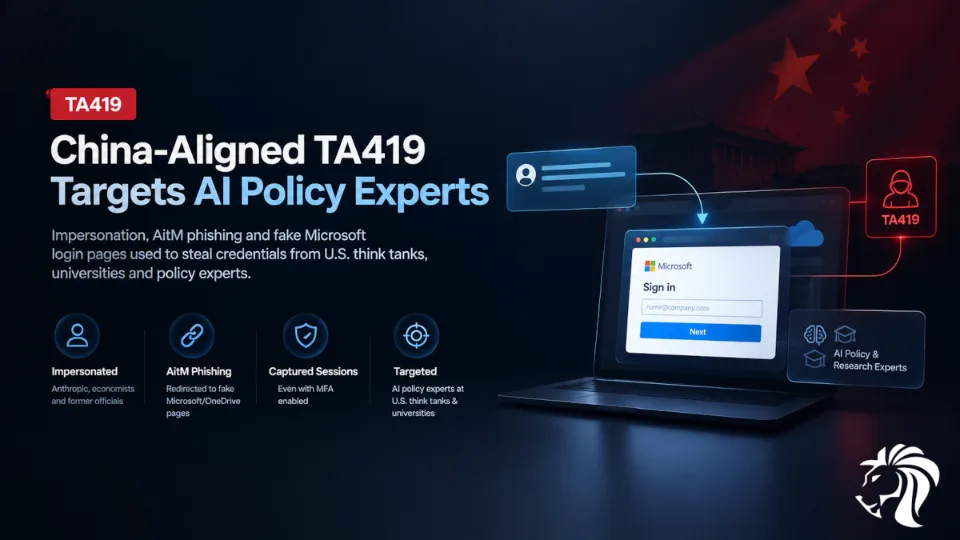
A highly targeted credential-phishing campaign has placed artificial intelligence policy and regulatory experts in the crosshairs of a China-aligned espionage group tracked by Proofpoint as TA419.
Rather than relying on conventional mass phishing, the group built credibility through personalized professional outreach, impersonating prominent economists, former U.S. government officials and an employee of AI company Anthropic. Targets included AI experts working at U.S. think tanks, universities and legal-sector organizations.
The campaign ultimately used Adversary-in-the-Middle (AitM) phishing and a customized Browser-in-the-Browser technique to target Microsoft 365 and Entra ID accounts, including authentication flows protected by multifactor authentication (MFA).
What is TA419?
Proofpoint describes TA419 as a China-aligned, espionage-motivated threat actor that has conducted targeted credential-phishing campaigns since at least April 2025.
Before its recent focus on AI policy, the group targeted individuals associated with U.S. and Japanese think tanks, defense contractors, universities and law firms. Its targeting has generally centered on areas such as defense, national security, energy, international relations and foreign policy.
The move into AI policy represents an extension of that targeting rather than a completely new direction. According to Proofpoint, the activity is likely intended to provide intelligence on developments in the U.S. AI policy and regulatory landscape.
Why are AI policy experts being targeted?
AI policy specialists can have access to information that is valuable well beyond technical research.
Their work may involve discussions around:
- AI regulation and governance
- Export controls
- National AI strategy
- AI supply chains
- Military applications of AI
- Policy development and government engagement
- Emerging technology risks
Proofpoint assessed that TA419's activity likely supports broader Chinese intelligence objectives related to these areas. Reuters separately reported that Proofpoint viewed the targeting pattern as indicating an intelligence interest in U.S. policymaking rather than technology theft alone.
How did the campaign establish trust?
One of the most notable aspects of the campaign was what happened before the phishing link appeared.
Beginning July 8, 2026, TA419 impersonated Lynne Edwards Parker, a former Principal Deputy Director of the White House Office of Science and Technology Policy, and later Heidi Crebo-Rediker, an economist and foreign-policy expert.
The messages did not immediately contain obvious malicious links. Instead, they presented plausible professional opportunities, including invitations to join a fictitious “AI Policy Advisory Committee” or contribute to a supposed Senate Committee on Foreign Relations report concerning AI export controls and supply chains.
The objective was to generate a response and establish enough credibility that a subsequent request would appear legitimate.
This is an important distinction from traditional phishing.
The attacker was not simply sending a malicious URL and hoping the recipient would click. The campaign used relationship-building as part of the attack chain.
The Anthropic impersonation campaign
TA419 had already demonstrated this approach earlier in 2026.
In February, the group impersonated a senior employee of Anthropic and targeted an AI policy analyst at a U.S. think tank.
The email used the subject:
“Request for Feedback on Military Integration of Claude”
The lure referenced ongoing discussions around the military use of Anthropic's Claude models, making the message highly relevant to the recipient's professional interests.
Like the later July campaigns, the interaction eventually led to an AitM credential-phishing infrastructure designed to obtain access to the target's cloud account.
The choice of subject matter demonstrates why highly specialized phishing can be difficult to identify. The attacker did not need to invent an obviously suspicious scenario; they used a topic that the target could reasonably expect to discuss professionally.
How the AitM attack works
After a target responded to the initial outreach, TA419 sent a shortened URL that purportedly provided additional information.
The link redirected the victim through multiple stages before reaching a fraudulent OneDrive-themed page.
Proofpoint observed the following general sequence:
Professional outreach → target replies → shortened URL → redirect chain → fake OneDrive page → Browser-in-the-Browser interface → Microsoft authentication → session theft
The first attacker-controlled stage used a fake OneDrive loading screen and a Cloudflare Turnstile check before forwarding the victim to the phishing infrastructure.
The July campaigns used the same first-stage domain and second-stage domain, according to Proofpoint.
AitM can undermine the protection users expect from MFA
The most technically significant aspect of the campaign is its use of Adversary-in-the-Middle phishing.
Instead of presenting a completely fake authentication system, the attacker proxies the victim's interaction with genuine Microsoft infrastructure.
TA419's phishing chain targeted Microsoft 365 and Entra ID through Microsoft's OfficeHome application. Proofpoint found that the infrastructure used a customized version of the open-source Frameless BitB Browser-in-the-Browser toolkit.
The victim is presented with a convincing browser-style login interface while the authentication process is relayed between the victim, the attacker and Microsoft's real infrastructure.
This allows the victim's password, MFA interaction and conditional-access checks to complete successfully while the attacker captures the resulting authentication session information.
In other words, a successful MFA prompt does not necessarily mean the authentication session is safe when the user is interacting with an adversary-controlled proxy.
Browser-in-the-Browser makes the phishing page more convincing
TA419 customized the open-source Frameless BitB toolkit rather than simply deploying a basic fake login page.
The technique creates a convincing browser-like authentication window inside the legitimate browser interface using web technologies.
Proofpoint found that TA419 had extended the toolkit with custom telemetry and automation capabilities. The infrastructure could track the victim's progress through the Microsoft sign-in process and monitor the session in real time.
The campaign also automated parts of the authentication flow, including handling the “Keep me signed in” prompt and submitting one-time authentication codes after validation.
This combination of social engineering, legitimate cloud infrastructure and AitM technology significantly reduces the visual clues that normally distinguish phishing from a genuine sign-in experience.
What happens after the credentials are entered?
The objective is not simply to collect a username and password.
Because the attacker proxies the authentication process, TA419 can capture the resulting session cookies after the login succeeds.
This creates a potentially more serious outcome than ordinary password theft. An attacker holding a valid session can potentially interact with cloud resources as an authenticated user without necessarily needing to repeat the complete login process.
That is why AitM attacks are particularly relevant to companies that rely heavily on MFA as their primary defense against credential phishing.
The infrastructure behind TA419
Proofpoint identified infrastructure patterns associated with the campaigns, including domains themed around file-sharing and cloud services.
TA419 also used Cloudflare's CDN to obscure backend hosting infrastructure, while domains were commonly registered through NameSilo.
Researchers additionally identified domains designed to impersonate specific entities, including the Heritage Foundation, the Japan-Taiwan Exchange Association and the official website associated with Japanese Defense Minister Shinjirō Koizumi.
These infrastructure choices reinforce the broader strategy: make the phishing environment appear familiar enough that the victim concentrates on the professional request rather than questioning the underlying technology.
Who is affected?
The immediate targeting observed by Proofpoint focused on individuals involved in AI policy and related areas at:
- U.S. think tanks
- Universities
- Legal-sector organizations
Reuters reported that the campaign involved fewer than 10 individuals at a handful of organizations, although Proofpoint's broader tracking shows TA419 has targeted a wider range of institutions and sectors since 2025.
The limited number of directly observed targets does not make the technique less significant. Highly targeted espionage campaigns are often designed around a small number of individuals whose access, expertise or professional networks make them strategically valuable.
What should companies do?
Organizations working in AI, research, policy, government affairs, defense or other strategically sensitive areas should treat highly personalized professional outreach as a potential security concern.
✅ Strengthen phishing-resistant authentication
Where possible, deploy phishing-resistant MFA, such as FIDO2/WebAuthn-based authentication.
Traditional MFA can help stop password-only attacks, but AitM techniques can proxy authentication and capture session material after the user successfully completes MFA.
✅ Train high-value users differently
Generic phishing awareness training is useful, but highly targeted users need more specific guidance.
Employees who regularly communicate with policymakers, researchers, executives or external experts should be trained to question:
- Unexpected collaboration requests
- Invitations to unfamiliar advisory groups
- Requests involving sensitive policy topics
- Follow-up links sent after an initial email conversation
- URL-shortened links
- Unexpected Microsoft or OneDrive authentication prompts
✅ Treat conversational trust as part of the attack surface
A legitimate-looking first email does not guarantee that later messages from the same conversation are safe.
Security teams should make users aware that attackers may deliberately establish a benign conversation before introducing the malicious component.
✅ Monitor cloud authentication telemetry
Security teams should monitor Microsoft 365 and Entra ID authentication events for unusual session activity, unexpected locations, abnormal device characteristics and suspicious access following phishing attempts.
Particular attention should be given to authentication events occurring immediately after a user interacts with an unusual external file-sharing or document-sharing site.
✅ Investigate suspected AitM incidents quickly
If a user may have entered credentials into a suspected AitM phishing page, simply changing the password may not be sufficient.
Security teams should investigate active sessions and authentication tokens, revoke appropriate sessions, review MFA activity and examine subsequent cloud-account activity.
The goal is to determine whether an attacker obtained an authenticated session rather than assuming the incident ended when the password was changed.
The bigger cybersecurity lesson
TA419's campaign demonstrates how modern espionage phishing is increasingly combining social engineering, legitimate cloud services, open-source phishing frameworks and authentication-proxy techniques.
The most dangerous part of the attack is not necessarily the fake login page itself. It is the sequence that precedes it.
A credible professional identity creates trust.
A relevant AI policy topic creates context.
A benign conversation creates familiarity.
A shortened URL hides the final destination.
A legitimate-looking OneDrive interface reduces suspicion.
AitM infrastructure then intercepts the authentication session.
Each step can appear relatively ordinary. Together, they form a highly targeted credential-theft operation.
For companies, the defensive lesson is clear: phishing defenses cannot focus only on malicious URLs or obviously fraudulent emails. Identity impersonation, conversational context, authentication telemetry and session security all need to be considered part of the same attack chain.
Final thoughts
TA419's targeting of AI policy experts illustrates how cyber espionage adapts to emerging strategic priorities.
The campaign did not need to compromise an AI model or exploit a software vulnerability. Instead, it targeted the people involved in shaping how AI is regulated, deployed and integrated into national strategy.
By impersonating trusted figures and combining that social engineering with AitM technology capable of capturing authenticated sessions, the attackers turned professional communication into the initial access vector.
For security teams, the priority should be to strengthen phishing-resistant authentication, improve detection of unusual cloud sessions and ensure that highly targeted personnel understand that a convincing professional conversation can itself be part of an attack.


