
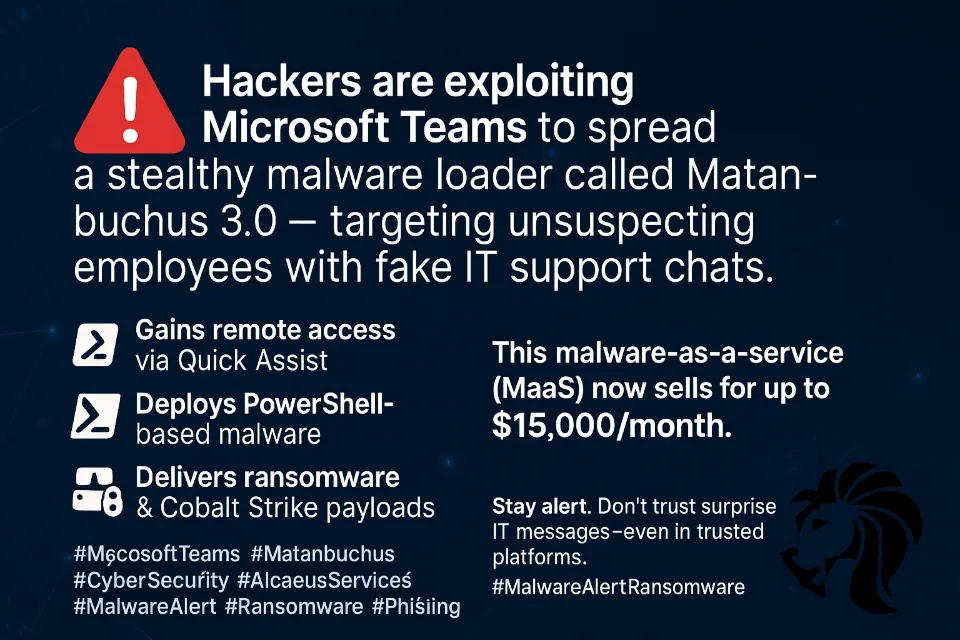
Threat researchers have uncovered a new wave of cyberattacks using Microsoft Teams as a delivery vector for Matanbuchus 3.0, a stealthy malware-as-a-service (MaaS) tool built for launching ransomware, reverse shells, and secondary malware.
What is Matanbuchus?
Originally advertised in 2021 on Russian-speaking underground forums, Matanbuchus is a malware loader—a lightweight program that runs in memory and downloads larger malicious payloads.
It’s been used to deploy:
- QakBot
- DanaBot
- Cobalt Strike beacons
- And precursors to ransomware attacks
Version 3.0, now actively sold for up to $15,000/month, includes:
- In-memory execution
- PowerShell & CMD reverse shell support
- Enhanced obfuscation
- Remote DLL, EXE & shellcode payload loading
- WQL query & COM task scheduling evasion
Attack Vector: Microsoft Teams
Security researchers from Morphisec observed an attack earlier this month where attackers:
- Initiated fake IT help desk chats over Microsoft Teams
- Tricked users into opening Quick Assist for screen sharing
- Launched a PowerShell script that deployed Matanbuchus
- Executed a malicious DLL using a renamed Notepad++ updater
This method of social engineering mimics previous tactics used by Black Basta ransomware groups.
How It Works
Once executed:
- Matanbuchus checks for admin privileges
- Scans for security tools and running services
- Sends data to a command-and-control (C2) server
- Awaits further instructions (typically EXE or MSI payloads)
Persistence is achieved by injecting shellcode into COM objects and scheduling hidden tasks—often manipulating ITaskService.
Why It Matters
The evolution of Matanbuchus reflects a broader trend:
- Abuse of legitimate system tools (aka LOLBins)
- Collaboration platform attacks (Microsoft Teams, Zoom)
- Weaponization of common user behaviors like IT trust
With Teams now embedded in most enterprise workflows, this attack method blends into normal activity, making detection harder.
Defense Tips from Alcaeus Services
- ✅ Disable Quick Assist in environments where it’s not required
- ✅ Train staff to never approve surprise IT remote sessions
- ✅ Enable EDR/XDR solutions with memory scanning
- ✅ Restrict script execution & DLL sideloading in Teams-integrated systems
- ✅ Monitor PowerShell behavior & COM object access
If you’re concerned about stealth loaders or remote access vectors in your environment, contact us today for a tactical vulnerability scan or endpoint hardening plan.


