
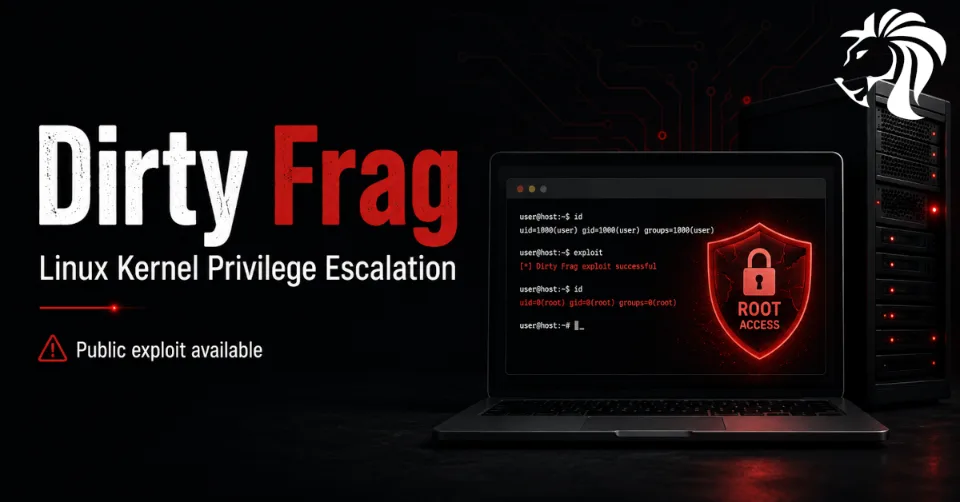
A newly disclosed Linux kernel vulnerability known as Dirty Frag is creating serious concern across the Linux ecosystem. A public proof-of-concept exploit is already available, and the issue affects several major Linux distributions, including Ubuntu, Red Hat Enterprise Linux, CentOS Stream, AlmaLinux, openSUSE Tumbleweed, and Fedora.
Dirty Frag is a local privilege escalation vulnerability. That means an attacker usually needs some level of access to the system first, such as a compromised user account, shell access, a foothold in a vulnerable application, a container escape opportunity, or another post-compromise entry point. Once inside, the flaw can potentially allow the attacker to escalate privileges to root.
Why Dirty Frag Matters
Dirty Frag is not a simple remote attack that instantly compromises Linux servers from the internet. However, it is still highly dangerous because it can turn limited access into full system control.
In many real-world breaches, attackers first gain access as a low-privileged user through phishing, stolen SSH keys, exposed applications, vulnerable web services, or compromised workloads. A reliable local privilege escalation exploit gives them the next step: root access.
With root privileges, an attacker may be able to:
- disable security tools
- access sensitive files
- dump credentials
- modify system configuration
- install persistence
- tamper with logs
- move deeper into the environment
- compromise containers or workloads running on the host
This makes Dirty Frag especially important for enterprise Linux servers, cloud workloads, container hosts, developer machines, CI/CD runners, and systems exposed to untrusted users.
A Chain of Two Kernel Vulnerabilities
Dirty Frag is not a single bug. It is a vulnerability chain involving two Linux kernel issues tracked as CVE-2026-43284 and CVE-2026-43500. Microsoft describes the affected components as kernel networking and memory-fragment handling areas involving esp4, esp6, and rxrpc.
Red Hat describes Dirty Frag as a local privilege escalation issue combining flaws in ESP/XFRM and RXRPC kernel functionality. ESP/XFRM is associated with IPsec-related encrypted network communication, while RxRPC is a protocol used by systems such as the Andrew File System.
The exploit abuses Linux page-cache behavior. The Linux kernel uses the page cache to keep file contents in memory for performance. Dirty Frag manipulates this memory-handling behavior to modify protected system data in memory without proper authorization.
That unauthorized modification can then be used to gain root privileges.
Similar to Dirty Pipe and Copy Fail — But Not the Same
Dirty Frag belongs to the same broader class of Linux kernel flaws as Dirty Pipe and Copy Fail, where improper handling of cached memory can lead to unauthorized modification of protected data.
However, Dirty Frag affects different kernel components and introduces additional attack paths. Microsoft notes that it expands exploitation opportunities compared with Copy Fail and may improve reliability.
Security researcher Hyunwoo Kim, also known as V4bel, described the exploit as deterministic and highly reliable because it does not depend on a race condition. This is significant because many local privilege escalation exploits are unstable, timing-dependent, or can crash the system if they fail. Dirty Frag is concerning because the public PoC suggests a much more dependable path to root.
In practical terms, this means defenders should not assume that mitigations for Dirty Pipe or Copy Fail are enough. Dirty Frag is conceptually related, but it is a separate vulnerability chain.
Public Exploit Increases Urgency
The situation is more urgent because a public proof-of-concept exploit is already available. Public exploit code reduces the barrier for attackers and can quickly turn a vulnerability from theoretical risk into operational risk.
Microsoft has also reported limited in-the-wild activity involving privilege escalation patterns associated with either Dirty Frag or Copy Fail. While this does not prove broad exploitation of Dirty Frag, it does mean defenders should treat the issue seriously and monitor affected systems closely.
Once an exploit is public, attackers can test it, modify it, and integrate it into post-compromise toolkits. For organizations running Linux at scale, this creates a race between patch deployment, mitigation, and attacker adoption.
Who Is Affected?
Dirty Frag affects a wide range of Linux distributions and kernel versions. Reports and vendor advisories indicate exposure across major enterprise and community distributions, including:
- Ubuntu
- Red Hat Enterprise Linux
- CentOS Stream
- AlmaLinux
- Fedora
- openSUSE Tumbleweed
- CloudLinux and related enterprise Linux environments
The exact level of exposure depends on kernel version, enabled modules, distribution backports, vendor patch status, and whether affected functionality is loaded or reachable. Red Hat, Microsoft, AlmaLinux, CloudLinux, Sysdig, and other security teams have published analysis or guidance around the issue.
Administrators should check their own distribution vendor advisories rather than relying only on upstream kernel status, because enterprise distributions often backport fixes differently.
Why Enterprise Environments Should Prioritize This
Dirty Frag is especially relevant in environments where local access is common or where attackers may already have an initial foothold.
High-risk systems include:
- shared Linux servers
- internet-facing application servers
- CI/CD runners
- developer workstations
- Kubernetes worker nodes
- container hosts
- bastion hosts
- VPN-connected servers
- systems with many SSH users
- systems running untrusted workloads
- cloud VMs with weak identity or endpoint controls
The biggest concern is post-compromise acceleration. An attacker who compromises a low-privileged account may not need a second sophisticated exploit. Dirty Frag could provide the escalation step needed to fully own the host.
For container environments, this also matters because host-level kernel vulnerabilities can become particularly dangerous when combined with container misconfigurations, privileged containers, mounted host paths, or weak workload isolation.
Patch Status and Mitigation
The Linux Kernel Organization has released patches for CVE-2026-43284, but reporting indicates that complete patch coverage for CVE-2026-43500 and distribution-level updates may vary. Administrators should follow their vendor’s official kernel update channels and apply fixed kernels as soon as they become available.
Until full patches are available and deployed, organizations should consider temporary mitigations where operationally safe.
Recommended actions include:
- apply vendor kernel updates as soon as available
- reboot into the patched kernel after installation
- disable unused rxrpc modules where possible
- assess whether esp4, esp6, and related IPsec/XFRM functionality can be temporarily disabled
- restrict unnecessary local shell access
- review SSH access and remove unused accounts
- enforce least privilege for users and services
- harden container workloads and avoid privileged containers
- run workloads as non-root where possible
- ensure SELinux or equivalent controls are enabled and enforcing where supported
- monitor for suspicious
su,sudo, shell, and privilege escalation activity - increase detection coverage for abnormal kernel module usage and unexpected root process creation
Microsoft also recommends hardening local access paths, containerized workloads, and monitoring for abnormal privilege escalation behavior. Red Hat similarly notes that measures limiting local access reduce exploitation risk, but they do not replace patching.
Detection and Monitoring Priorities
Because Dirty Frag is a local privilege escalation issue, detection should focus on suspicious post-compromise activity rather than only network exposure.
Security teams should look for:
- unexpected
suorsudoactivity - low-privileged users suddenly spawning root shells
- unusual changes to
/etc/passwd,/etc/shadow, PAM files, or sudoers configuration - new SUID binaries
- suspicious kernel module loading or unloading
- unexpected use of IPsec or rxrpc-related modules
- abnormal container escape indicators
- unusual process ancestry leading to root execution
- endpoint alerts involving privilege escalation attempts
- sudden disabling of logging, EDR, auditd, or security agents
Organizations using Linux runtime security tools should update detection rules and review vendor-provided content for Dirty Frag indicators.
Practical Response Plan
For administrators managing Linux fleets, the response should be structured and fast:
- Inventory affected systems
Identify Linux hosts, kernel versions, and distributions across servers, cloud VMs, containers, CI/CD systems, and developer environments. - Check vendor advisories
Follow Ubuntu, Red Hat, SUSE, AlmaLinux, Fedora, CloudLinux, and other relevant vendor channels for patched kernel availability. - Apply available patches
Install fixed kernel packages as soon as possible and confirm systems are actually running the patched kernel after reboot. - Apply temporary mitigations
Disable unused rxrpc/IPsec-related functionality only where safe and tested. - Reduce local access
Remove unnecessary shell access, review SSH keys, disable unused accounts, and restrict administrative workflows. - Increase monitoring
Watch for privilege escalation behavior, especially on internet-facing servers and systems with prior suspicious activity. - Review compromised hosts carefully
If signs of exploitation are found, treat the system as potentially fully compromised because root access may have been obtained.
Final Thoughts
Dirty Frag is a serious Linux kernel vulnerability because it combines public exploit availability, broad distribution impact, and a reliable path from local access to root privileges.
The flaw does not remove the need for an initial foothold, but in modern attacks, that is often only the first step. Once attackers obtain limited access, local privilege escalation vulnerabilities like Dirty Frag can give them complete control of the system.
Organizations should not wait for widespread exploitation before acting. Linux administrators should review exposure, apply kernel updates as soon as they are available, restrict local access, and monitor closely for privilege escalation activity.
Dirty Frag is another reminder that Linux hardening is not only about protecting the network edge. It is also about controlling what happens after an attacker gets inside.


