
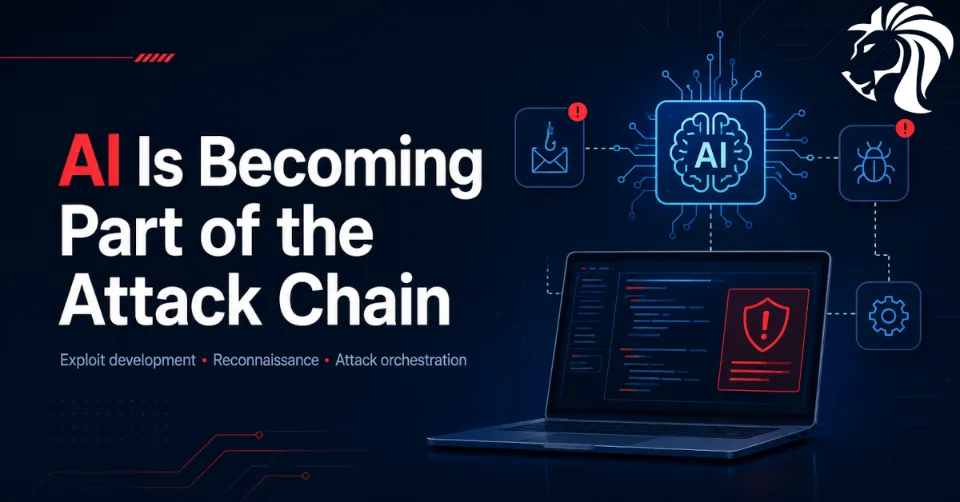
🤖 Artificial intelligence is no longer being used by attackers only for simple phishing emails or basic malware scripting. According to new research from Google’s Threat Intelligence Group, threat actors are now experimenting with AI in more advanced areas of cyber operations, including vulnerability research, exploit development, attack automation, and even real-time orchestration.
This marks an important shift in the threat landscape. AI is not replacing skilled attackers, but it is helping them work faster, test more ideas, automate repetitive tasks, and scale operations that previously required more manual effort.
For defenders, this means one thing: cyberattacks are moving closer to machine speed.
From Phishing Assistance to Exploit Development
When large language models became widely available, many early attacker use cases were relatively predictable. Threat actors used AI to write better phishing lures, translate messages, generate scripts, summarize technical content, and support basic reconnaissance. That has now evolved.
Google’s research shows that adversaries are increasingly using AI tools to support vulnerability research and exploit development. In one particularly notable case, Google identified a threat actor using a zero-day exploit that the company believes was likely developed with AI assistance.
The exploit was implemented in a Python script and was designed to bypass two-factor authentication on a popular open-source, web-based system administration tool. The vulnerability required valid user credentials, but the actor was reportedly preparing to use it at scale.
Google disclosed the issue to the relevant vendor in an attempt to disrupt potential malicious activity.
What made the script stand out was not only what it did, but how it was written. The code reportedly contained unusually detailed educational-style documentation, structured formatting, helper menus, and even a hallucinated CVSS score — characteristics that suggested an AI model had likely assisted in the discovery or weaponization process.
AI-Assisted Vulnerability Research Is Growing
Google’s Threat Intelligence Group has observed multiple state-linked actors using AI to support vulnerability research.
A suspected China-linked actor, tracked as UNC2814, was seen prompting Gemini to act as a network security researcher investigating embedded devices, including TP-Link firmware. The prompts focused on auditing for pre-authentication remote code execution vulnerabilities.
North Korean actor Silent Chollima, also known as APT45, has also been observed using thousands of repetitive prompts to analyze different CVEs and validate proof-of-concept exploits. This kind of repeated AI-assisted testing can help attackers refine their exploit development process and improve their chances of success.
Threat actors are also using specialized vulnerability data sources, including historical repositories such as WooYun legacy data, which contains tens of thousands of real-world vulnerability cases collected by the Chinese bug bounty platform WooYun between 2010 and 2016.
This shows that attackers are not only asking AI simple questions. They are feeding it structured vulnerability knowledge and using it to reason across large volumes of technical material.
Agentic AI Tools Are Entering the Attack Chain
Another major development is the use of agentic AI tools.
Unlike standard chatbot-style interactions, agentic tools can perform multi-step tasks, interact with systems, validate findings, and continue working toward a goal with limited human input. In the hands of attackers, this can significantly increase speed and scale.
Google’s report described threat actors experimenting with tools such as OpenClaw, OneClaw, Hextrike, and Strix to assist with vulnerability research and offensive operations.
In one case, a China-nexus actor reportedly used agentic tools during attacks against a Japanese technology company and an East Asian cybersecurity platform. These tools helped maintain persistence across the attack surface and automate vulnerability validation.
This suggests a gradual move toward AI-driven attack frameworks where reconnaissance, testing, validation, and exploitation can be partially automated.
PromptSpy: AI Used for Attack Orchestration
One of the most striking examples mentioned in the report involves an Android backdoor known as PromptSpy.
Originally detailed by ESET, PromptSpy abuses Gemini to help the malicious app remain visible in the Android recent apps list. However, Google’s analysis found that its AI usage went further.
The backdoor used AI to navigate the Android user interface and interpret real-time user activity. This could help the malware decide what to do next based on what is happening on the device.
Even more concerning, the malware could capture biometric-related interaction data and replay authentication gestures to regain access to a compromised device.
This is important because it shows attackers experimenting with AI not only as a coding assistant, but as part of the operational logic of malware itself.
Human-in-the-Loop Is Shifting Toward Human-on-the-Loop
Traditionally, cyber operations have been heavily human-driven. Attackers performed reconnaissance, selected targets, tested exploits, moved laterally, and adjusted tactics manually.
AI is beginning to change that model.
The industry is already seeing a similar shift on the defensive side, where security teams are moving from human-in-the-loop systems to human-on-the-loop systems. In this model, AI agents perform moment-to-moment tasks while humans supervise and intervene when necessary.
Threat actors are moving in the same direction.
AI-driven tools may increasingly handle reconnaissance, vulnerability validation, environment analysis, phishing personalization, lateral movement support, and operational decision-making. Human operators may focus more on strategy, target selection, and final approval.
That makes attacks faster, more scalable, and harder to respond to using traditional manual processes.
The Risk: Machine-Time Attacks Against Human-Speed Defenses
John Hultquist, chief analyst at Google Threat Intelligence Group, warned that defenders risk facing “machine time threats at human speed.”
This is the core challenge.
Attackers using AI can move faster through research, exploit testing, phishing preparation, and operational execution. If defenders rely only on manual investigation, slow patching cycles, and delayed alert triage, they may quickly fall behind.
The danger is not only that AI makes attacks more sophisticated. It also makes them faster.
Security teams could face:
- more convincing phishing and social engineering campaigns
- faster vulnerability discovery and weaponization
- automated exploit validation
- larger volumes of reconnaissance
- quicker lateral movement
- AI-assisted malware decision-making
- more alerts and incidents than analysts can manually process
This creates a major pressure point for organizations that already struggle with alert fatigue and patch management.
What Organizations Should Do Now
Defenders need to treat AI-enabled attacks as an emerging operational reality, not a distant future threat.
Key actions include:
- use AI-assisted detection and triage to reduce response time
- prioritize patching for internet-facing and high-value systems
- monitor for abnormal behavior, not only known indicators
- strengthen identity controls and require phishing-resistant MFA
- improve endpoint visibility across servers, workstations, and mobile devices
- monitor suspicious automation and unusual scripting activity
- review access to administrative tools and web-based management platforms
- test incident response processes against fast-moving attack scenarios
- secure CI/CD, cloud, and developer environments
- train teams to recognize AI-enhanced social engineering
Organizations should also review how they validate vulnerabilities, monitor exploit attempts, and detect lateral movement. Defensive workflows must become faster and more automated without removing human oversight from critical decisions.
Final Thoughts
AI is changing cyber operations on both sides.
For attackers, it lowers the barrier to entry, improves speed, helps with exploit research, supports social engineering, and enables more autonomous workflows. For defenders, it creates both a challenge and an opportunity.
The organizations that rely only on traditional manual defense will struggle as attackers increasingly operate at machine speed. The organizations that combine strong security fundamentals with AI-assisted detection, automation, and response will be better positioned to keep up.
The message is clear: AI is no longer just a productivity tool. In cybersecurity, it is becoming part of the attack chain.


