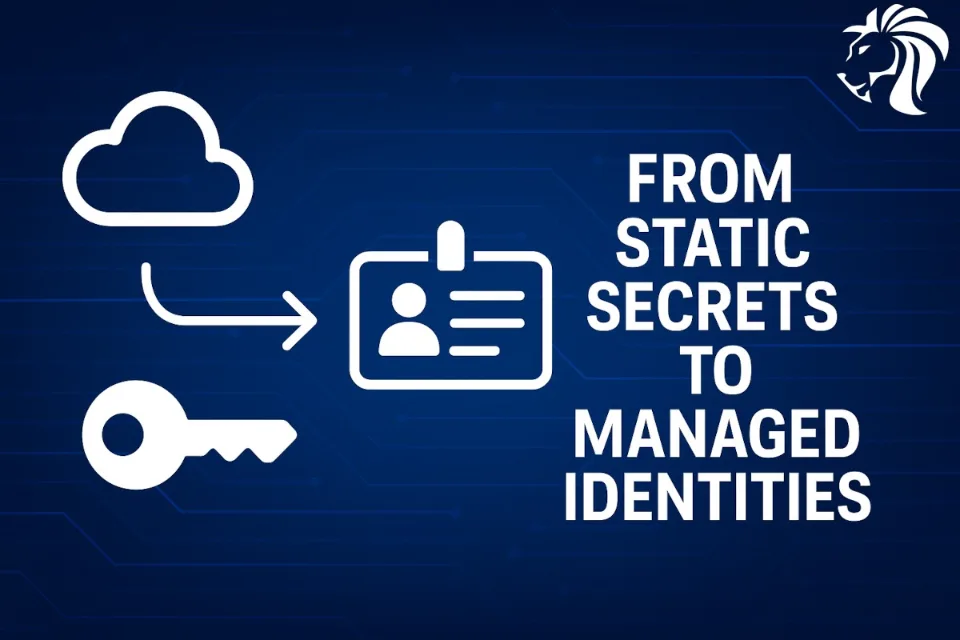
As machine identities surge across cloud environments, enterprises are rapidly transitioning from static credentials — such as passwords, API keys, and tokens — to managed identities that eliminate the need for manual key rotation and secret storage.
The Problem with Static Secrets
For decades, static secrets have been the backbone of workload authentication. However, they create operational and security headaches:
- Complex rotation schedules
- Credential leaks in code repositories
- Cross-cloud authentication friction
- Time-consuming lifecycle management
Even centralized tools like HashiCorp Vault or CyberArk — while improving visibility — can’t escape the core issue: a growing ocean of static secrets that still require human oversight.
The Shift to Managed Identities
Managed identities replace static credentials with automatically issued, short-lived tokens that rotate securely and natively within cloud platforms.
🔹 AWS IAM Roles: Automatically generate temporary credentials for workloads without storing static keys.
🔹 Azure Managed Identities: Allow apps to authenticate to Key Vault, Storage, and other services without connection strings.
🔹 Google Cloud Service Accounts: Enable seamless authentication across multicloud environments.
🔹 GitHub / GitLab OIDC Authentication: Remove the need for long-lived cloud access credentials in CI/CD pipelines.
The Business Case
Organizations that implemented managed identities reported:
- 95% reduction in credential management time per component
- 75% faster developer onboarding
- Hundreds of hours saved annually in cross-platform authentication setup
The result? A stronger security posture, faster deployment cycles, and reduced risk of human error.
The Hybrid Reality
While managed identities are the future, the complete elimination of static secrets isn’t yet possible.
- Legacy systems and third-party APIs still depend on static keys.
- Cross-organization integrations often require shared secrets.
Experts recommend a hybrid approach — reducing static secret use by 70–80%, and managing the remainder with strong secret management solutions.
Discovering Non-Human Identities (NHI)
Before transitioning, organizations must understand what they already have.
Many IT teams uncover hundreds or thousands of forgotten API keys and tokens scattered across systems — often without clear ownership.
Platforms like GitGuardian NHI Security now help enterprises:
- Map dependencies between services and credentials
- Identify candidates for managed identity migration
- Quantify risk exposure and plan strategic transitions
Alcaeus Services Insight
Modern identity isn’t about removing secrets entirely — it’s about minimizing exposure and automating trust.
At Alcaeus Services, we help organizations modernize authentication by:
- Discovering unmanaged credentials
- Designing hybrid managed identity architectures
- Integrating cloud-native identity solutions across Azure, AWS, and GCP
The path forward is clear:
Fewer secrets, stronger identity, and automation-first security.