
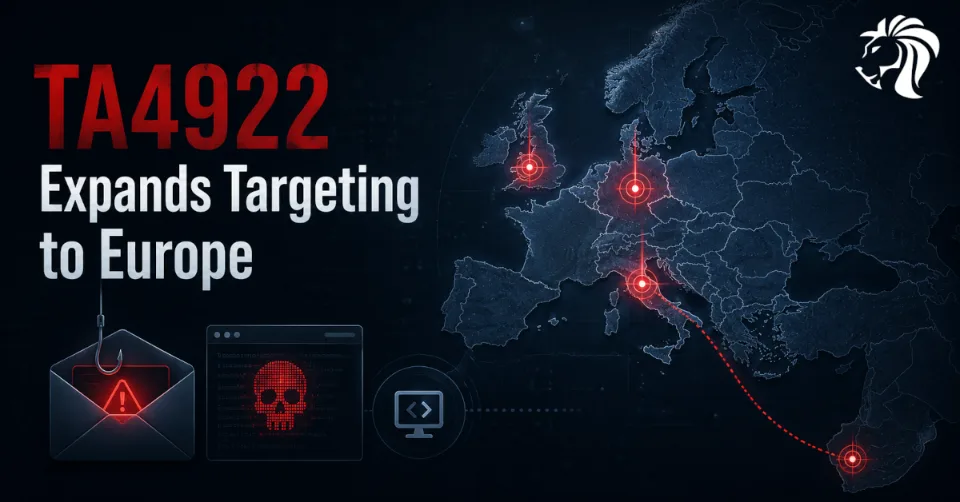
A China-linked cybercrime group known as TA4922 has expanded its targeting beyond East Asia, launching phishing and malware campaigns against organizations in the United Kingdom, Germany, Italy, and South Africa.
According to Proofpoint, the group has shown a rapid operational tempo and a constantly evolving malware arsenal. Its toolkit includes known malware families such as ValleyRAT, also known as Winos 4.0, and Atlas RAT, also known as AtlasCross RAT, as well as newly documented tools called RomulusLoader and SilentRunLoader.
While China-linked threat groups are often discussed in the context of espionage, TA4922 appears to be more financially motivated. The group’s activity is focused on gaining remote access to victim environments for purposes such as data theft, fraud, access resale, and long-term persistence.
The campaign shows how quickly regional cybercriminal operations can scale into wider international threats.
Who Is TA4922?
Proofpoint tracks the activity under the name TA4922 and describes the group as a Chinese-speaking threat actor historically focused on East Asia.
The group is believed to have some overlap with Silver Fox, another China-linked threat cluster. However, TA4922’s activity appears more aligned with cybercrime than traditional state espionage.
The group’s likely objectives include:
- remote access to victim systems
- credential theft
- data theft
- fraud enablement
- access resale
- deployment of additional malware
- long-term persistence inside compromised environments
This makes TA4922 dangerous not only to organizations in its original target regions, but also to companies worldwide.
Expansion Into Europe and South Africa
Recent TA4922 activity shows a notable geographic expansion.
The group has targeted organizations in:
- United Kingdom
- Germany
- Italy
- South Africa
- Japan
- Southeast Asia
This shift matters because it shows the group is not limited to a fixed region or sector. Once threat actors refine a working phishing and malware delivery model, they can quickly adapt it to new countries, languages, and business themes.
Proofpoint noted that TA4922 conducts more unique campaigns than any other threat actor it tracks, highlighting the group’s ability to rapidly change lures, payloads, and targeting.
Phishing Lures: HR, Tax, Invoices, and Compliance
TA4922 uses business-themed phishing campaigns to lure victims into engaging with malicious content.
Recent themes include:
- human resources communications
- corporate messages
- tax authority notices
- invoice-related emails
- benefits notifications
- compliance updates
- business process requests
These themes are effective because they match normal workplace activity. Employees are used to receiving HR messages, tax documents, invoices, compliance requests, and internal business communications.
The goal is to make the phishing message feel routine enough that the victim opens the attachment, follows the instructions, or continues the conversation through another channel.
Moving Conversations Out of Email
One of TA4922’s notable tactics is attempting to move conversations away from corporate email and into out-of-band channels, such as:
- LINE
- Microsoft Teams
This is important because enterprise email security controls are usually stronger than controls around personal messaging apps or informal collaboration channels.
By shifting the conversation outside email, attackers may bypass:
- email security gateways
- phishing detection
- attachment scanning
- link rewriting
- mailbox logging
- automated reporting workflows
- security awareness banners
Once the conversation moves to a messaging app, the attacker can build trust, deliver malicious files, request credentials, or guide the victim through a fraud scenario with fewer enterprise controls watching.
This tactic should be treated as a warning sign.
Malware Arsenal: Atlas RAT, RomulusLoader, and SilentRunLoader
TA4922’s campaigns use multiple malware families and loaders.
- Atlas RAT, also known as AtlasCross RAT, is used to establish remote access to compromised systems. It has been delivered through phishing campaigns using DLL side-loading. A remote access trojan can allow attackers to control systems, execute commands, collect information, and deploy additional payloads.
- RomulusLoader is a C-based loader observed in corporate and HR-themed campaigns. The loader is delivered through DLL side-loading and can be used to deploy additional tools. In some campaigns, it has been used to install AnyDesk and SyncFuture, giving attackers remote access and further control.
- SilentRunLoader is a Python-based loader and stealer described as “vibe-coded,” suggesting it may have been developed or assisted using AI coding tools.
It has been used in campaigns targeting the U.K. and Southeast Asia. SilentRunLoader can drop additional executables designed to harvest sensitive data from Google Chrome, including:
- stored credentials
- cookies
- browsing information
This type of browser data theft can support account takeover, session hijacking, fraud, and further compromise.
DLL Side-Loading as a Common Delivery Technique
Several TA4922 campaigns rely on DLL side-loading.
DLL side-loading is a technique where attackers place a malicious DLL alongside a legitimate executable. When the legitimate program runs, it loads the attacker’s DLL instead of the expected safe component.
This technique is popular because it can abuse trusted applications and make malicious execution appear more legitimate.
It can help attackers:
- bypass basic security checks
- hide behind signed executables
- blend into normal process activity
- avoid obvious malware execution patterns
- launch payloads more stealthily
Organizations should monitor for unusual DLL loading behavior, especially when files are executed from temporary folders, user profile paths, archive extraction directories, or unexpected locations.
Campaign Timeline
Proofpoint observed several TA4922 campaigns in March and April 2026.
Examples include:
- March 6: HR-themed lures targeting Japanese organizations to deliver Atlas RAT via DLL side-loading.
- March 23: Corporate and HR-themed lures targeting Japanese organizations to deliver RomulusLoader.
- March 30: Tax authority-themed lures targeting U.K. organizations to deliver SilentRunLoader and steal Chrome data.
- April 2: HR communication lures targeting organizations in the U.K. and Germany to deliver Atlas RAT.
- April 7: Invoice-themed lures targeting Japanese organizations to deliver Atlas RAT.
- April 10: Benefits and compliance-themed lures targeting Southeast Asia and the U.K. to deliver SilentRunLoader.
- Mid-April: Business and tax-themed lures targeting Japan and Germany to deliver RomulusLoader, which then deployed AnyDesk and SyncFuture.
This pace shows that TA4922 can rapidly change themes and payloads across different regions.
Financial Motivation With Espionage Potential
Proofpoint assesses TA4922 as financially motivated.
However, the capabilities of its malware also create surveillance potential.
Remote access tools, browser data theft, credential harvesting, and persistent access can support fraud and access resale. But the same capabilities could also be useful to espionage groups.
This creates a blurred threat model.
A financially motivated group may steal data for resale. Another actor may later buy access and use it for espionage. Or the same infrastructure may be repurposed for higher-value intelligence collection.
Organizations should not assume that “financially motivated” means low impact.
Why Chrome Data Theft Is Dangerous
Several TA4922 campaigns focused on stealing data from Google Chrome.
Browser data can be extremely valuable because it may contain:
- saved passwords
- session cookies
- browsing history
- autofill data
- authentication tokens
- access to SaaS applications
- internal web portal sessions
Stealing cookies can sometimes allow attackers to bypass normal login flows and reuse an active session.
This can be especially dangerous if the victim has access to business systems, finance portals, CRM platforms, cloud consoles, HR systems, or administrative tools.
Defensive Recommendations
Organizations should treat TA4922-style activity as a serious phishing and malware threat.
Recommended actions include:
- train users to be cautious with HR, tax, invoice, benefits, and compliance-themed messages
- investigate attempts to move conversations from email to WhatsApp, LINE, or personal messaging apps
- block or monitor unusual file sharing through out-of-band channels
- detect DLL side-loading from user-writable directories
- monitor for unexpected AnyDesk or remote access tool installation
- alert on suspicious Chrome credential or cookie access
- inspect Python-based loaders and unusual script execution
- monitor for unexpected archive extraction followed by executable launch
- restrict execution from temporary folders and Downloads directories
- enforce multi-factor authentication for business applications
- use endpoint detection rules for RAT behavior
- monitor for unusual outbound connections from newly executed binaries
Security teams should also correlate email activity with endpoint alerts and messaging-platform behavior where visibility is available.
What to Watch For
Potential warning signs include:
- HR or tax-themed emails from unfamiliar senders
- messages asking to continue the discussion on WhatsApp, LINE, or Teams
- unexpected attachments related to benefits, compliance, invoices, or tax documents
- legitimate executables loading unknown DLLs
- new AnyDesk installations
- unknown Python scripts running on user endpoints
- suspicious access to browser credential stores
- unusual Chrome cookie access
- remote access tools appearing after phishing interaction
- outbound traffic to unfamiliar infrastructure
Any combination of phishing, browser data theft, and remote access tooling should be treated as a potential compromise.
Final Thoughts
TA4922’s recent campaigns show a fast-moving cybercriminal operation expanding beyond its original focus area.
The group uses convincing business lures, out-of-band messaging tactics, DLL side-loading, remote access tools, and evolving loaders such as RomulusLoader and SilentRunLoader to compromise organizations across multiple regions.
Although the group appears financially motivated, its malware capabilities could support broader surveillance, data theft, and access resale.
Monitor business-themed phishing, watch for attempts to move conversations outside email, detect DLL side-loading, and treat developer, HR, finance, and business communication workflows as high-risk attack surfaces.
TA4922 is a reminder that cybercriminal groups can evolve quickly — and so must defensive visibility.


