Surge in Hacktivist Attacks After Middle East Military Escalation

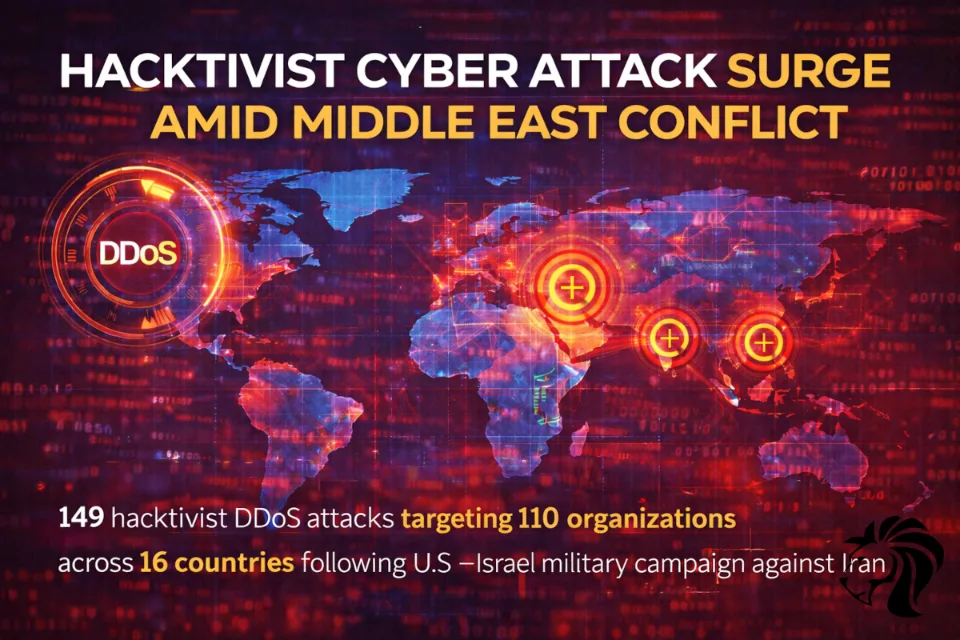
Cybersecurity researchers are reporting a sharp increase in hacktivist cyber operations following the U.S.–Israel military campaign against Iran.

Security News 1 min read

Surge in Hacktivist Attacks After Middle East Military Escalation

Cybersecurity researchers are reporting a sharp increase in hacktivist cyber operations following the U.S.–Israel military campaign against Iran.

Between Feb 28 – Mar 2, at least 149 DDoS attack claims targeted 110 organizations across 16 countries, with the majority aimed at government and critical infrastructure.

Key observations

• Keymous+ and DieNet accounted for nearly 70% of attack activity
• 12 hacktivist groups involved, including NoName057(16) and Handala Hack
• Middle East organizations were the primary targets
• Government (47.8%), finance, and telecom sectors heavily impacted

Kuwait, Israel, and Jordan experienced the highest concentration of attacks.

What this means

Cyber operations are increasingly becoming a parallel battlefield to physical conflicts.

Threat actors aligned with geopolitical agendas often combine:
• DDoS campaigns
• Data leaks
• Psychological operations

Organizations in Israel, the U.S., and allied countries may face increased cyber pressure.

Recommended defensive actions

• Increase threat monitoring and intelligence feeds
• Reduce exposed internet-facing services
• Review IT/OT network segmentation
• Harden identity and cloud environments
• Isolate IoT and critical infrastructure devices

As geopolitical tensions escalate, cyber retaliation is becoming immediate and global.
Blog

Microsoft 5 min read

Keys, Tenants and Trust: two Microsoft cloud incidents that call for action this week

Two Microsoft cloud services were hit in November 2026, and each needs a different response. In Azure API Management (APIM) Classic, attackers exploited a flaw to steal stored secrets, and Norway's security agency says those secrets should be treated as exposed. In Entra Connect Health, attackers accessed tenant metadata and administrator email addresses, but Microsoft says passwords and authentication tokens were not exposed.

Security 5 min read

Ransomware group lists Nvidia on its leak site, but offers no proof

On 18 November 2026, the ransomware group The Gentlemen added Nvidia to its dark web leak site and set a countdown to 28 November. The listing contains no sample files, screenshots or data inventory. Nvidia says it is investigating an incident that may have affected a third-party partner, and that it has found no indication that its own systems or networks were affected. The claim is unverified.

Security 4 min read

Patch Splunk, and retire any internet-facing SonicWall Gen 6 firewall

On 18 November 2026, Splunk patched nearly 140 vulnerabilities in Enterprise, Enterprise Security and SOAR, including several critical flaws, with no active exploitation reported. SonicWall told customers to retire Gen 6 firewalls from the internet edge, as they no longer receive patches for any severity. Patch Splunk and replace Gen 6 devices.