Operation DoppelBrand: Fortune 500 Brands Turned Against Themselves

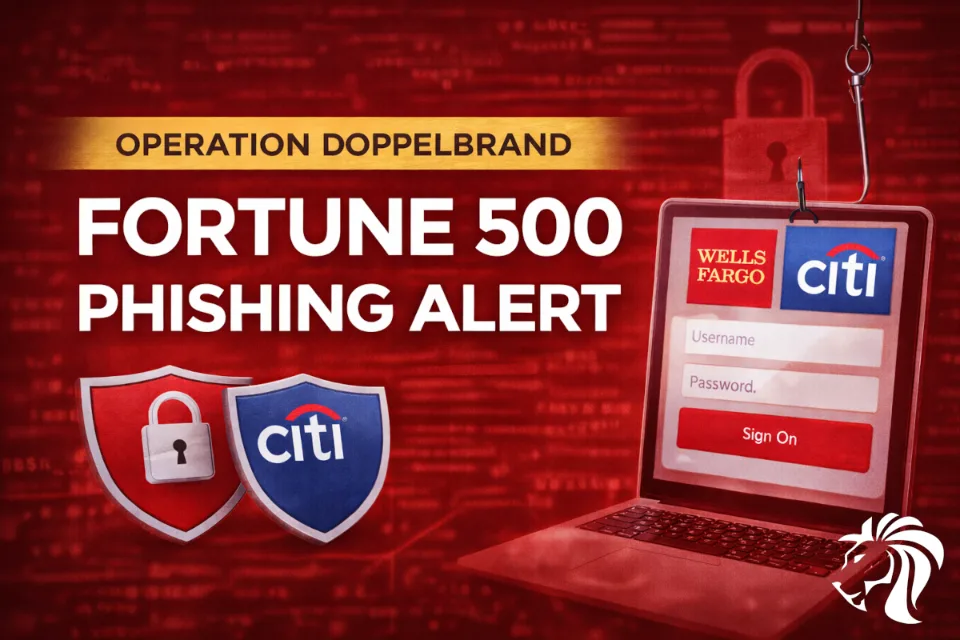
A financially motivated threat actor known as GS7 is running a large-scale phishing campaign targeting Fortune 500 companies — using pixel-perfect impersonation of legitimate login portals to steal credentials.

Security News 1 min read

Operation DoppelBrand: Fortune 500 Brands Turned Against Themselves

A financially motivated threat actor known as GS7 is running a large-scale phishing campaign targeting Fortune 500 companies — using pixel-perfect impersonation of legitimate login portals to steal credentials.

The campaign, active since December, impacts major financial institutions, tech firms, healthcare providers, and telecom companies across the U.S. and Europe.


What’s happening?

🔐 Brand-accurate phishing portals
GS7 registers hundreds of lookalike domains and replicates official login pages with near-perfect precision.

🌍 Mass domain infrastructure
150+ malicious domains recently registered, traffic routed via Cloudflare to hide backend servers.

📲 Real-time credential exfiltration
Stolen usernames, passwords, IP data, device fingerprints, and geolocation details are sent instantly to Telegram bots.

🖥️ Post-compromise access
Victims may unknowingly download RMM tools, enabling persistent access or resale to ransomware groups.


Why this is concerning

This isn’t spray-and-pray phishing.
It’s highly structured, infrastructure-heavy, and likely aligned with Initial Access Broker (IAB) activity.

GS7 may not be the final attacker — just the one selling the door.


Defensive takeaways

• Enforce phishing-resistant MFA
• Monitor for lookalike domains
• Restrict unauthorized RMM deployments
• Validate financial login URLs directly (avoid email links)
• Leverage IoC feeds where available

Phishing isn’t getting louder.
It’s getting more precise.
Blog

Microsoft 5 min read

Keys, Tenants and Trust: two Microsoft cloud incidents that call for action this week

Two Microsoft cloud services were hit in November 2026, and each needs a different response. In Azure API Management (APIM) Classic, attackers exploited a flaw to steal stored secrets, and Norway's security agency says those secrets should be treated as exposed. In Entra Connect Health, attackers accessed tenant metadata and administrator email addresses, but Microsoft says passwords and authentication tokens were not exposed.

Security 5 min read

Ransomware group lists Nvidia on its leak site, but offers no proof

On 18 November 2026, the ransomware group The Gentlemen added Nvidia to its dark web leak site and set a countdown to 28 November. The listing contains no sample files, screenshots or data inventory. Nvidia says it is investigating an incident that may have affected a third-party partner, and that it has found no indication that its own systems or networks were affected. The claim is unverified.

Security 4 min read

Patch Splunk, and retire any internet-facing SonicWall Gen 6 firewall

On 18 November 2026, Splunk patched nearly 140 vulnerabilities in Enterprise, Enterprise Security and SOAR, including several critical flaws, with no active exploitation reported. SonicWall told customers to retire Gen 6 firewalls from the internet edge, as they no longer receive patches for any severity. Patch Splunk and replace Gen 6 devices.