
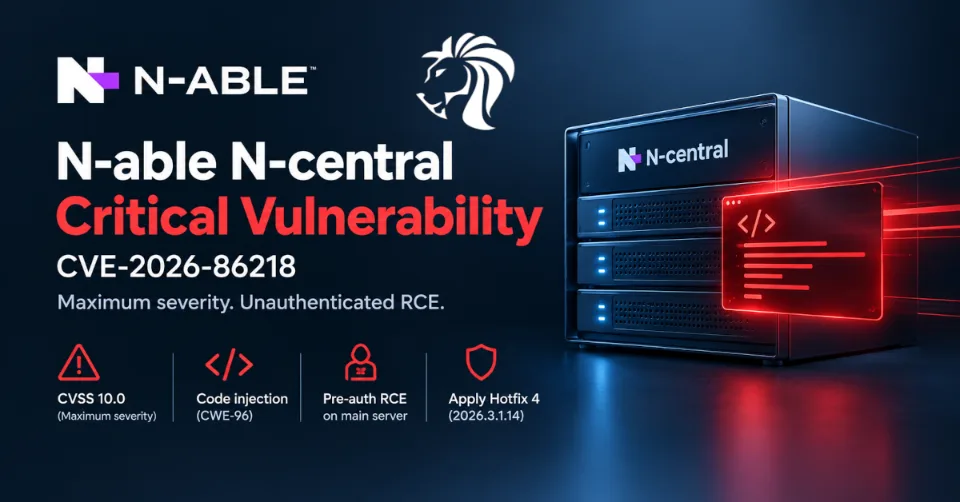
N-able has released an emergency security update for N-central, its remote monitoring and management (RMM) platform, to address CVE-2026-86218. This maximum-severity vulnerability can allow an unauthenticated remote attacker to execute code on the N-central server.
The vulnerability is rated CVSS 4.0: 10.0, the highest possible score. Under CVSS 3.1, the flaw carries a 9.8 Critical rating. N-able has classified it as a static code injection vulnerability (CWE-96).
The timing is particularly significant: this is the fourth N-central security hotfix released in roughly five weeks, following updates issued in August and another hotfix released only hours before the latest.
What happened?
N-able released N-central 2026.3 Hotfix 4, build 2026.3.1.14, on September 6, 2026.
According to N-able, CVE-2026-86218 can provide pre-authenticated remote code execution on the N-central server. In practical terms, an attacker does not need to authenticate to the vulnerable service before attempting to execute malicious code.
This makes the vulnerability particularly serious for organizations and managed service providers using self-hosted N-central servers that are reachable by potentially untrusted networks.
Why is this vulnerability so dangerous?
N-central is not an ordinary endpoint application. It is an RMM platform used by IT teams and managed service providers to centrally monitor and administer computers, servers and networks.
Compromise of an RMM management server can therefore create a potentially powerful position for an attacker.
Depending on the privileges and configuration of the compromised environment, successful exploitation could provide a pathway toward:
- Execution of malicious code on the N-central server
- Establishment of persistent access
- Theft of credentials or sensitive configuration information
- Further access to systems managed through the platform
- Abuse of the RMM infrastructure as a launch point for additional attacks
These are potential consequences of compromising an RMM platform; N-able has not publicly stated that every vulnerable installation would automatically result in these outcomes.
The exploitation question needs careful attention
There is an important discrepancy in N-able's current communications.
The N-able security hotfix documentation says that the company has no confirmation that CVE-2026-86218 has been exploited in production environments, while warning that unpatched systems remain at risk.
However, N-able's associated incident notification says that the newly identified vulnerability has been observed being exploited in the wild.
Because these statements conflict, it is safer to describe the exploitation status as unclear, rather than definitively claiming widespread exploitation.
What is not unclear is the urgency of the patch: N-able is explicitly telling on-premises customers to apply Hotfix 4 immediately.
Who is affected?
The vulnerability affects N-central builds before 2026.3.1.14.
Importantly, this includes systems that were updated to Hotfix 3, which addressed two different vulnerabilities only a day earlier.
N-able's supported direct upgrade paths to the secure build include:
- N-central 2025.4
- N-central 2026.1
- N-central 2026.2
- N-central 2026.3
- N-central 2026.3.1 with earlier hotfixes
Organizations running older versions should follow N-able's documented upgrade path.
- Hosted N-central customers
Customers using hosted N-central / NCOD do not need to perform the upgrade themselves. N-able states that hosted environments have already had the necessary protections applied.
- On-premises customers
Organizations running their own N-central infrastructure should upgrade to: N-central 2026.3.1.14 — Hotfix 4 as soon as possible.
What should organizations do now?
For organizations operating N-central on-premises, the priority should be straightforward:
✅ Identify every N-central server
Determine which installations are self-hosted and verify their exact build numbers.
✅ Upgrade to 2026.3.1.14
Do not assume that installing Hotfix 3 is sufficient. Hotfix 4 specifically addresses CVE-2026-86218.
✅ Review exposure
If the N-central management interface is directly reachable from the internet, review whether that exposure is actually required.
Huntress has recommended restricting access to the N-central console through mechanisms such as IP allowlisting or VPN access where possible, particularly while organizations work through the patching process.
✅ Audit accounts
N-able recommends auditing N-central user accounts for unexpected users as a precaution.
✅ Investigate suspicious activity
If an affected server was exposed to the internet before patching, security teams should consider reviewing authentication activity, administrative changes, unusual processes and outbound network connections.
✅ Review the wider RMM environment
RMM platforms have privileged access by design. A compromise should therefore be treated as potentially significant even if there is no immediate evidence that endpoints were affected.
A broader warning for MSPs
The latest N-central issue also highlights a larger security challenge for managed service providers.
RMM platforms concentrate administrative power. One compromised management server can potentially become much more valuable to an attacker than compromising an individual workstation.
The recent sequence of N-central vulnerabilities illustrates why these systems deserve the same defensive attention as other high-value infrastructure such as identity providers, remote-access gateways and virtualization management platforms.
Organizations should consider:
- Restricting administrative interfaces to trusted networks
- Enforcing strong authentication and MFA
- Separating management infrastructure from ordinary user networks
- Monitoring privileged changes
- Maintaining reliable administrative logging
- Having a rapid emergency-patching procedure for RMM infrastructure
- Regularly reviewing which systems and accounts the RMM platform can access
Final thoughts
CVE-2026-86218 is particularly serious because it combines maximum severity, remote reachability and pre-authentication against a platform designed to manage other systems.
The situation around exploitation is still developing, and N-able's public statements currently contain conflicting descriptions of whether exploitation has been confirmed. That uncertainty should not be used as a reason to delay remediation.
For self-hosted N-central deployments, Hotfix 4 is the required security update.
Privileged management platforms must be treated as critical infrastructure. When an unauthenticated RCE affects an RMM server, patching the management layer should be an immediate security priority—not a routine maintenance task.


