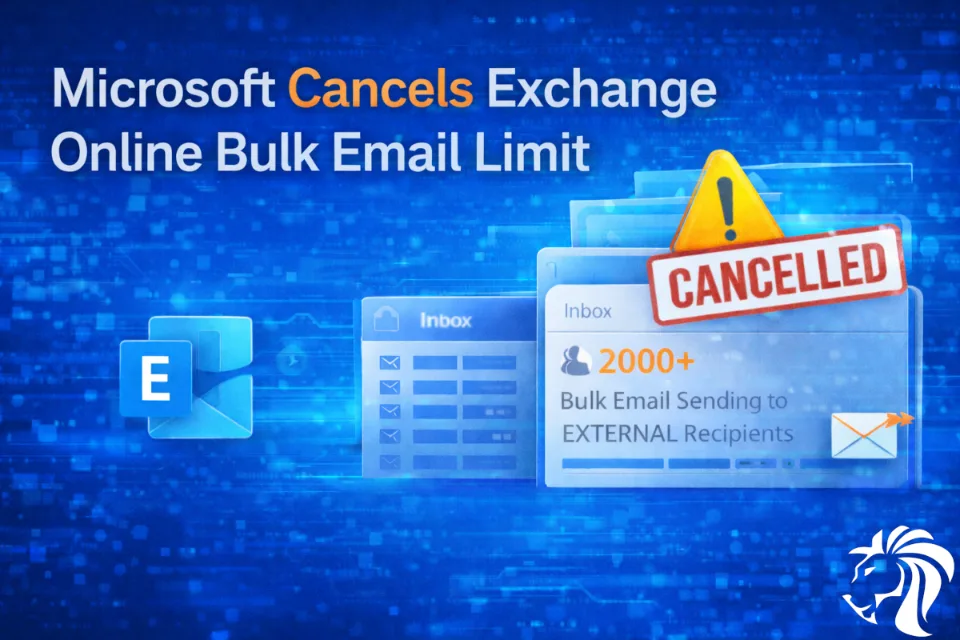
Microsoft cancels Exchange Online bulk email limit

Microsoft has announced that it is canceling its planned daily limit of 2,000 external recipients for Exchange Online bulk email senders — a restriction originally introduced to combat spam and unfair usage.

Microsoft News 2 min read

Microsoft cancels Exchange Online bulk email limit

Microsoft has announced that it is canceling its planned daily limit of 2,000 external recipients for Exchange Online bulk email senders — a restriction originally introduced to combat spam and unfair usage.

The limit, announced in April 2024, was scheduled to roll out between July and December 2025. However, after significant customer feedback, Microsoft decided to halt enforcement indefinitely.

“Customers have shared that this limit creates significant operational challenges… Your feedback matters, and we're committed to solutions that balance security and usability without causing unnecessary disruption,” the Exchange Team stated.

What’s changing — and what’s not

❌ Cancelled:

  • Daily 2,000 external recipient limit per mailbox

✅ Still enforced:

  • Recipient Rate Limit: 10,000 recipients
  • Tenant External Recipient Rate Limit: 5,000 external recipients per day

Microsoft emphasized that future protections will rely on smarter, adaptive anti-abuse mechanisms, rather than hard limits that disrupt legitimate business workflows.

Industry-wide trend

Google is also tightening email security:

  • Bulk senders must authenticate with SPF, DKIM, and DMARC
  • Unauthenticated or high-spam senders are automatically blocked
  • One-click unsubscribe and fast opt-out handling are mandatory

Together, these changes signal a broader shift toward email hygiene, authentication, and reputation-based controls, rather than blunt rate limiting.

📌 Takeaway:
Bulk emailing is still possible — but poor authentication and bad sending practices are no longer tolerated.

Blog

Microsoft 5 min read

Keys, Tenants and Trust: two Microsoft cloud incidents that call for action this week

Two Microsoft cloud services were hit in November 2026, and each needs a different response. In Azure API Management (APIM) Classic, attackers exploited a flaw to steal stored secrets, and Norway's security agency says those secrets should be treated as exposed. In Entra Connect Health, attackers accessed tenant metadata and administrator email addresses, but Microsoft says passwords and authentication tokens were not exposed.

Security 5 min read

Ransomware group lists Nvidia on its leak site, but offers no proof

On 18 November 2026, the ransomware group The Gentlemen added Nvidia to its dark web leak site and set a countdown to 28 November. The listing contains no sample files, screenshots or data inventory. Nvidia says it is investigating an incident that may have affected a third-party partner, and that it has found no indication that its own systems or networks were affected. The claim is unverified.

Security 4 min read

Patch Splunk, and retire any internet-facing SonicWall Gen 6 firewall

On 18 November 2026, Splunk patched nearly 140 vulnerabilities in Enterprise, Enterprise Security and SOAR, including several critical flaws, with no active exploitation reported. SonicWall told customers to retire Gen 6 firewalls from the internet edge, as they no longer receive patches for any severity. Patch Splunk and replace Gen 6 devices.