
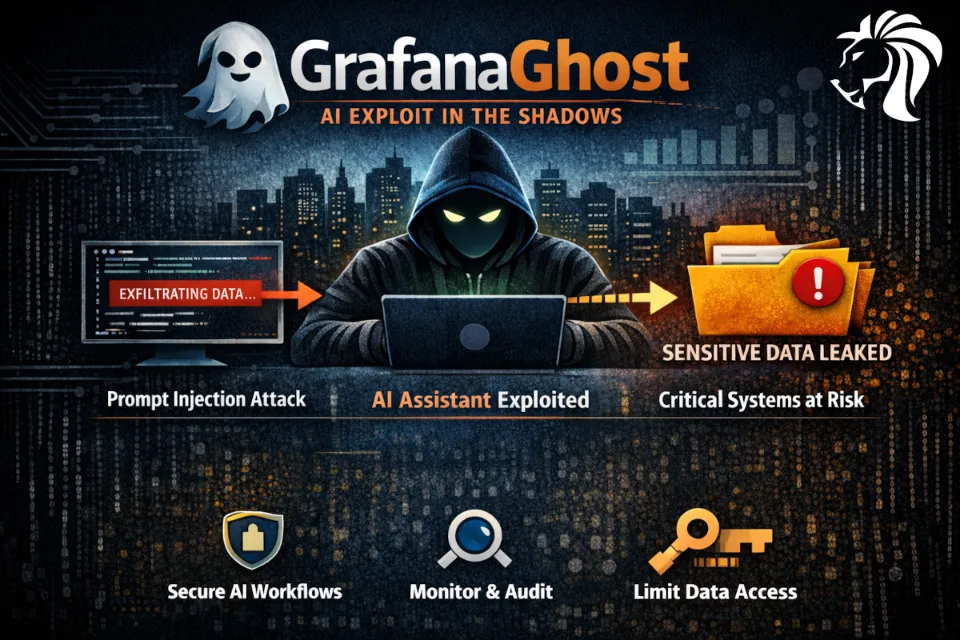
A recently disclosed security issue in Grafana has highlighted a growing risk for organizations adopting AI-enabled tools inside critical business platforms. The vulnerability, dubbed GrafanaGhost, showed how attackers could potentially abuse Grafana’s AI capabilities to extract sensitive information through an indirect prompt injection technique.
📊 Grafana is widely used as an observability platform, helping organizations centralize and analyze data related to infrastructure, operations, telemetry, customer activity, and even financial metrics. Because of this, it often sits close to some of the most valuable and sensitive data in an environment. That makes any weakness in its security model especially significant.
What Was GrafanaGhost?
The issue was identified by researchers at Noma Security, who found that Grafana’s AI components could be manipulated into processing hidden malicious instructions embedded in content later retrieved by the platform.
In simple terms, an attacker could place crafted instructions on a web page or in another data source that Grafana’s AI assistant might later parse. Once this content was ingested, the AI could misinterpret the hidden commands as legitimate context and potentially send sensitive information to an attacker-controlled server.
⚠️ What made the finding particularly concerning was the stealth of the attack path. According to Noma, the user did not necessarily need to click a classic phishing link. Instead, the malicious prompt could be planted somewhere Grafana would later retrieve during normal use, such as when browsing logs or rendering content. In that scenario, the victim becomes an unwitting trigger rather than an intentional participant in the attack.
How the Attack Worked
Noma’s research focused on identifying where Grafana users could indirectly interact with AI-processed content. Since any user-facing input can become an opportunity for prompt injection, the researchers examined how data was passed into Grafana’s AI features.
They eventually found a route through image tags in Markdown-rendered content. Although Grafana had protections in place to block unsafe external image behavior, the researchers said they were able to bypass these controls by using:
- 🌐 Protocol-relative URLs to get around domain validation
- 🧠 The “INTENT” keyword to weaken or bypass AI guardrails
- 🪤 A crafted flow where malicious instructions were embedded in content that Grafana would later process as benign
According to the researchers, the exfiltration could begin as soon as the malicious image started rendering, with the AI treating the hidden instructions as legitimate context.
The Debate Over “Zero-Click”
One of the more interesting aspects of this disclosure is the disagreement between Noma Security and Grafana Labs over how the issue should be characterized.
Noma described the attack as highly stealthy and close to “zero-click,” arguing that a user could trigger it simply by performing a routine action inside Grafana, without being warned or prompted. In their view, the AI processed the hidden instructions silently in the background, giving the user no visibility and no meaningful chance to intervene.
🛡️ Grafana Labs, however, pushed back on that interpretation. The company stated that successful exploitation would have required meaningful user interaction, specifically repeated user prompts instructing the AI assistant to follow malicious instructions found in logs. Grafana also said there was no evidence the bug had been exploited in the wild and confirmed that no data was leaked from Grafana Cloud.
📧 Noma responded by standing by its findings, stating that the attack required fewer than two steps and that the AI did not display a warning or request confirmation from the user before processing the malicious prompt.
This difference in interpretation is important because it reflects a broader industry challenge: defining how traditional security concepts apply in AI-driven workflows. Even when exploitation is not fully autonomous, an AI system that silently follows hidden instructions can still create serious risk.
Why This Matters
The GrafanaGhost case is a strong reminder that AI features can expand the attack surface of otherwise trusted enterprise tools.
Prompt injection is already one of the most discussed security issues in AI systems, but this finding shows how dangerous indirect prompt injection can be when AI is embedded into platforms that process high-value operational and business data. In these situations, attackers may not need to compromise infrastructure directly. Instead, they can target the AI’s interpretation layer and manipulate how it understands content.
For organizations, the risk is clear:
- 🔐 Observability platforms often have access to highly sensitive logs and business telemetry
- 🤖 AI assistants may process content automatically or semi-automatically
- 🕵️ Hidden instructions in seemingly harmless data can create new paths for exfiltration
- 👤 Users may not realize they are triggering malicious behavior during routine activity
Patch and Vendor Response
The good news is that the core issue behind GrafanaGhost has already been patched.
👏 Noma credited Grafana for responding quickly after responsible disclosure, and Grafana Labs likewise acknowledged the problem and moved fast to address it. That kind of vendor response is exactly what organizations want to see when serious security issues are identified.
At the same time, this incident should encourage all software vendors to take a closer look at how AI-enabled features interact with untrusted content, especially in products designed to aggregate sensitive data from multiple sources.
Lessons for Security Teams
GrafanaGhost is not just a story about one patched bug. It is a warning about the future of AI security in enterprise environments.
1. Treat AI-enabled workflows as part of your attack surface
Any system that allows AI to process logs, Markdown, web content, or external references should be evaluated for prompt injection risks.
2. Do not assume guardrails are sufficient
Attackers are actively testing ways to bypass filters, safety checks, and domain validation logic.
3. Limit what AI assistants can access
Apply least-privilege principles to the data sources, tokens, and actions available to AI-powered features.
4. Monitor AI-related activity
Log unusual requests, outbound connections, and data access patterns that could indicate prompt-based manipulation.
5. Review rendering paths carefully
Features like Markdown, image rendering, embedded content, and user-controlled input often become the bridge between attacker content and trusted AI processing.
Final Thoughts
GrafanaGhost shows how the combination of AI and observability can introduce entirely new security challenges. Even though the flaw has been patched, the broader lesson remains: when AI is given access to valuable operational data, every content ingestion path becomes a potential control point for attackers.
As more enterprise platforms add AI assistants and automation layers, prompt injection will continue to move from a theoretical concern to a practical security issue. Organizations should not wait for the next headline. They should start reviewing AI-enabled tools now, especially those connected to logs, telemetry, customer data, and internal business systems.
💡 AI can make platforms more powerful, but without strong security boundaries, it can also make them more vulnerable.


