
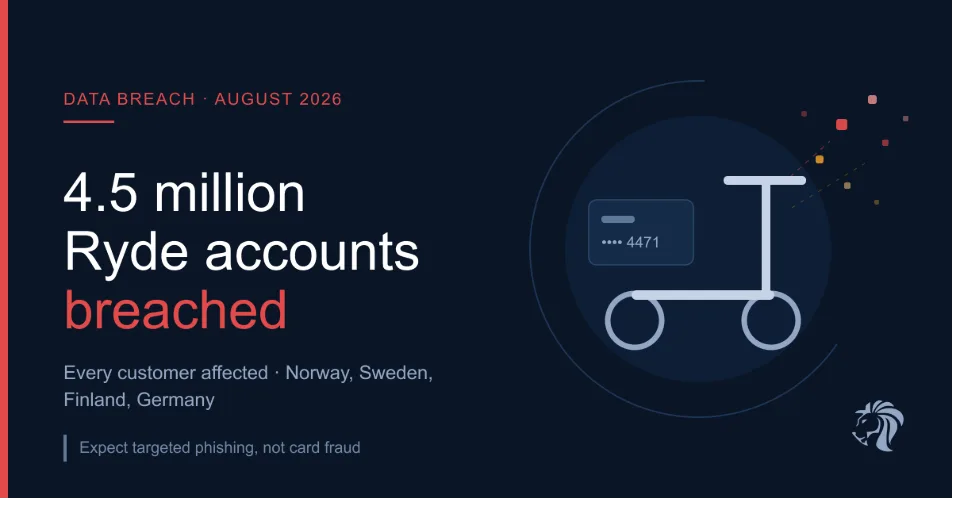
A single night's intrusion was enough to expose the entire customer base of one of the Nordics' largest e-scooter operators. On 2 August 2026, Norwegian micromobility company Ryde Technology discovered that an unauthorised party had accessed its systems and copied customer data. Ryde Technology is a Norwegian company established in Oslo in 2019, and the breach reaches into four countries. No ransomware was deployed, no ransom was demanded, and no systems were locked. That is precisely what makes this case worth studying: the attacker did not need to break anything. They only needed to copy.
What happened
During the night leading into Sunday 2 August, Ryde discovered that an unauthorised party had gained access to its systems and copied customer data. The unauthorised access was stopped shortly afterwards. Chief executive Tobias Balchen told Norwegian news agency NTB that approximately 4.5 million accounts in Norway, Sweden, Finland and Germany may be covered by the breach, and that the company had no indication at that stage of who was behind it. Of those, around 1.6 million accounts are in Norway, according to VG.Ryde states that all customer accounts are affected. The exact data varies by user depending on what they registered, and may include phone number, email address, date of birth, only the first six and last four digits of the payment card number, an unverified name and address for a small number of customers, and payment history covering rides, purchases and fees.
Two things were explicitly ruled out. Beyond the location where an account was created, no other location data such as ride history was extracted — so there is no indication that data about where customers have travelled was affected. Ryde also does not store full payment card numbers; those sit with its payment service provider.Ryde notified the Norwegian Data Protection Authority (Datatilsynet), reported the incident to the police, and began notifying affected customers, including through an in-app alert. Datatilsynet has confirmed it received the breach notification and that the case is under assessment, adding that the priority now is proper follow-up and information for affected users. Senior adviser Eirik Gulbrandsen told NTB the authority is first focused on those affected, and will then examine what happened.
Crucially, Balchen confirmed Ryde was not locked out of its own systems, that everything was running normally, and that no financial demands or threats had been received from those responsible — stressing that this was not that type of attack.
How the attack works
Ryde has not disclosed the intrusion route, and no vulnerability identifier has been published. What the company has described is a data exfiltration incident — the theft of a copy of data — rather than a ransomware or destructive attack.
The distinction matters in plain terms:
- Ransomware encrypts or destroys data to force a payment. The victim notices immediately because systems stop working.
- Exfiltration quietly copies data out. Systems keep running normally, which is why detection often depends on spotting unusual outbound data volumes or unexpected database queries rather than on any visible failure.
The card data field deserves explanation. Ryde says only the first six and last four digits of card numbers were involved. The first six digits are the BIN (Bank Identification Number), which identifies the issuing bank and card type. The last four are the digits printed on receipts. Together they cannot be used to make a payment — a full 16-digit number, expiry date and security code would be needed. But they are extremely effective for impersonation: they let a caller state your bank and the last four digits of your card correctly, which most people treat as proof of legitimacy.
Ryde has since closed the access points it identified, rebuilt the affected systems, and replaced passwords and cryptographic keys, while the investigation into the full scope continues.
Why it matters
The stolen dataset is not valuable for direct card fraud. It is valuable as raw material for social engineering, and Ryde said so itself.
The company warned that anyone with access to the stolen information may contact customers and appear credible by referring to a payment they actually made, including the correct amount, date and the last four digits of their card. That combination — real transaction, real amount, real date, real card digits — defeats the most common way people judge whether a caller is genuine.
There is a specific Nordic dimension. Ryde explicitly told customers never to share passwords, one-time banking codes or BankID credentials with anyone who contacts them, no matter how much they appear to know, because neither Ryde nor their bank will ever ask for this. BankID is the national electronic identity used across Norway and Sweden for banking, government services and contract signing. A successful BankID or one-time-code handover is far more damaging than a stolen card number.
Datatilsynet made the same point, noting that when personal and contact information goes astray the risk of targeted fraud attempts rises, and advising affected users to be especially alert to unexpected emails, text messages and phone calls.
Who is affected
- Approximately 4.5 million accounts across Norway, Sweden, Finland and Germany, including roughly 1.6 million in Norway.
- Every account holder, according to Ryde — there is no unaffected subset.
- Minors. Ryde's notice includes specific guidance for customers under 18, advising them to tell a parent or another trusted adult so they can review the information together. Shared e-scooter services have a substantial teenage user base, and date of birth was among the exposed fields.
- Businesses indirectly, where employees used work email addresses or corporate cards for rides.
What attackers can do with this data
- High-context phishing and vishing. Messages or calls that cite a genuine Ryde charge, its date and your card's last four digits — then pivot to "confirm your identity" via a link or a code.
- BankID and one-time-code theft. The end goal in Nordic fraud is rarely the card; it is authenticated access to banking or identity services.
- Bank impersonation. With the BIN, an attacker knows which bank to impersonate before making contact.
- Identity verification bypass. Date of birth, plus name and address where present, are common knowledge-based verification answers for telecoms, banks and support desks.
- SIM-swap groundwork. Verified mobile numbers tied to confirmed identity details support attempts to port a number and intercept SMS codes.
- Data enrichment. Merged with older breach dumps containing passwords, this dataset builds far more complete profiles for account takeover.
There is no public evidence that the data has been posted or sold, and no attribution has been made. No ransom demand had been received as of the company's statements to NTB. That is not reassuring in itself: quiet datasets are frequently used privately for fraud rather than advertised.
What users should do
- Never share one-time codes, BankID credentials or passwords with anyone who contacts you, however much they already know about you.
- Hang up and call back. Ryde advises ending the conversation if unsure and contacting the company or your bank directly using a number you obtained independently.
- Don't click links in messages claiming to be from Ryde. The company says it will never ask you to log in through a link in a text message or email, and recommends opening the app or typing the address into your browser yourself to check whether the same information appears there.
- You do not need to block your card, per Ryde — because full card numbers are held by its payment provider, not by Ryde — but review statements anyway.
- Change your password if you reused it on Ryde and elsewhere, and enable two-factor authentication on your email and bank accounts.
- Talk to your teenager if they use the app.
What organisations should learn from it
- Tokenisation limits card fraud, not fraud. Outsourcing full card numbers to a payment provider worked exactly as designed here. It did not prevent a mass social-engineering exposure, because masked card digits plus transaction history are enough for convincing impersonation. Treat masked PANs and payment metadata as sensitive, not residual.
- Minimise what you collect and retain. Date of birth was one of the most useful fields for attackers. Every optional field is permanent liability.
- Instrument bulk reads. Alert on abnormal query volumes and outbound data transfers, not just on failed logins. Exfiltration produces no outage to alert you.
- Rotate everything after an intrusion. Ryde rebuilt affected systems and replaced passwords and cryptographic keys — the correct assumption being that anything reachable by the attacker is compromised.
- Prepare the fraud-wave response, not just the breach notice. Ryde's disclosure is a reasonable template: it named specific data fields, stated plainly what customers did not need to do, explained how to verify a genuine message, and addressed minors directly. Publishing a standing "we will never ask for X" policy has real defensive value.
- Know your clocks. Under GDPR Article 33, controllers must notify the supervisory authority within 72 hours of becoming aware of a personal data breach. Ryde also filed a police report — worth building into playbooks in advance rather than deciding under pressure.
Final thoughts
Ryde did several things right. It detected and cut off the access, notified the regulator and police, told customers quickly, and was specific about which fields were taken. The company was never locked out and never extorted.
And every one of its 4.5 million customers is still exposed — because the damage in this breach was never going to arrive as a fraudulent card charge. It will arrive as a phone call that knows your name, your bank, your last ride and what you paid for it.
Not storing sensitive data is not the same as being safe. Once identity and transaction context leaks, the vulnerability moves from your systems to your customers' judgement — and that is far harder to patch.


