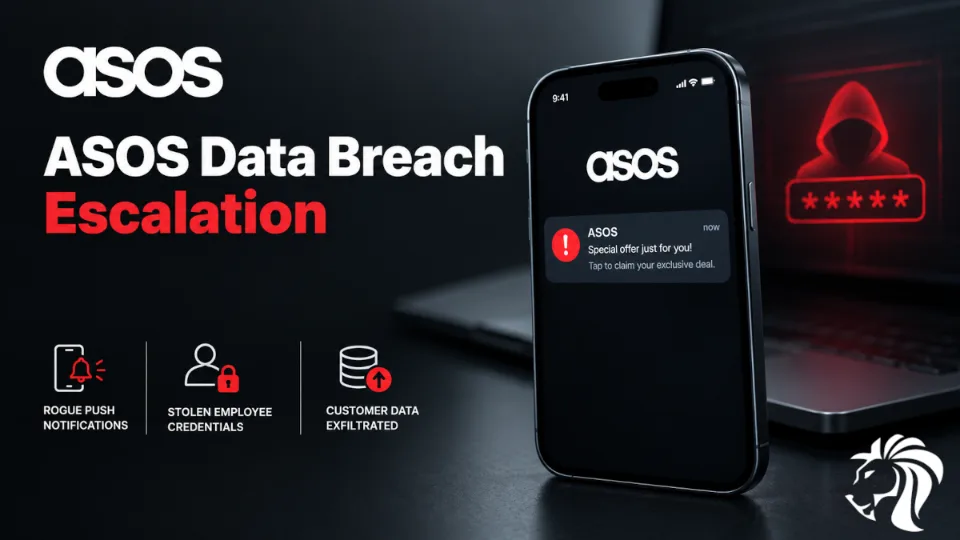
On the morning of 6 October 2026, ASOS customers received a push notification from the ASOS app. It was headed "ASOS HACKED", it was addressed to the company's Data Protection Officer and IT team, and it had not been sent by ASOS.
That inversion is the story. Customers did not learn about the incident from a breach notification letter, a press release or a regulator. They learned about it from the attackers, delivered through the retailer's own trusted channel, on their own lock screens.
Two days later ASOS confirmed what had happened: an employee was socially engineered out of their login credentials, and those credentials were used to reach customer data on third-party platforms. The company says names and contact details were exposed. A sample the attackers gave the BBC contained considerably more than that.
What happened
The notification
The rogue alerts began reaching devices early on 6 October. The message claimed the attackers had fully compromised ASOS's cloud data environment, named the data platform Snowflake, threatened to leak customer information, and urged ASOS staff to make contact on Telegram. A group calling itself "Xuanye Group" claimed responsibility.
The demand was addressed to ASOS's DPO and IT department — but the people actually receiving it were shoppers. That was the point. This was extortion routed through the victim's customer base to create maximum pressure.
The group later posted a "final statement" claiming it held customer information, said it would leave the data untouched for a set period, and stated that payment data was not affected. It published no proof, no record count and no sample to the public. BleepingComputer tried to reach the attackers; the only available contact route required payment.
The company's response
ASOS filed a statement with the London Stock Exchange the same day, describing unauthorised activity affecting a third-party platform used to host customer data and handle communications. It put an in-app notice live telling customers to disregard the rogue alert and not to click the external link it contained.
On 8 October, ASOS escalated its disclosure. In a notification shared with BleepingComputer, the company said an unauthorised party gained access to an employee account by impersonating a trusted contact in order to obtain login credentials, and that those credentials were then used to reach information on certain third-party platforms the company uses. ASOS locked down the affected platforms and opened an investigation with external experts, law enforcement and regulators.
The disclosure gap
This is the part that matters, and where your assumptions should be careful.
What ASOS has confirmed was exposed:
Full names
Contact details
Certain non-personal account-related information
ASOS states that payment card information and account passwords were not accessed, that its website and app remain safe to use, and that customers need take no action on their accounts.
What the BBC found in the attackers' sample:
Names, addresses, phone numbers and email addresses
Dates of birth
Customer ID numbers
Customers' ASOS search histories
Dates of birth and search histories are not "contact details", and they are not non-personal. The escalation in this story is therefore less a formal admission by ASOS than a widening gap between the company's description and the material journalists have actually seen. ASOS has not publicly reconciled the two.
What remains unverified
No affected-customer count has been published. ASOS has around 17 million customers, but that is the size of its customer base, not a breach figure. BleepingComputer asked for a number and did not receive one.
The Snowflake claim is disputed. Proton stated that Snowflake itself was not compromised in this attack. Dan Bird of Horizon3 noted that the system used to send ASOS push notifications is separate from Snowflake — so reaching the notification tool does not demonstrate reaching the data warehouse. Researchers at Cybernews found no leaked files or data samples proving the attackers hold a full customer database.
Regulatory notification was initially absent. The BBC reported on 6 October that ASOS had not at that point informed the UK's Information Commissioner's Office. Under UK GDPR, a qualifying personal data breach must be reported to the ICO within 72 hours of becoming aware of it.
Check Point assesses this incident as unrelated to a separate ASOS US incident in July 2026, which appeared to involve credential stuffing.
How the attack works
There was no exotic exploit here. The chain is short, and every link is familiar.
1. Impersonation of a trusted contact. The attackers posed as someone the employee had reason to trust — a colleague, supplier or service provider — and obtained their login credentials. This is social engineering, not hacking in the technical sense. ASOS employs roughly 2,800 people. One of them was enough.
2. Reuse of those credentials against third-party platforms. The credentials opened access to SaaS tools ASOS uses for customer data and communications. This is the structural weakness: modern retail runs on a stack of marketing, messaging and analytics platforms, each holding a slice of customer data, often reached with the same corporate identity and frequently with weaker access controls than core systems.
3. Abuse of a trusted output channel. Having reached the communications platform, the attackers did something most data thieves do not: they used it. The push notification system is designed to send authenticated, branded messages to millions of phones. In an extortion scenario, that is not a side effect — it is leverage.
4. Extortion through the customer base. Rather than negotiating privately or listing data for sale, the group put its demand in front of customers and then briefed the media. The effect is reputational pressure applied directly, bypassing the company's communications function entirely.
The key insight: a marketing or notification platform is usually governed as a marketing tool, with access handed out broadly and monitored lightly. But it is simultaneously a database of customers and a megaphone pointed at them. Compromising one identity gave the attackers both.
Why it matters
Trusted channels are now an attack surface. Organisations spend heavily on teaching customers to trust official apps and distrust email. This incident inverts that training: the most alarming message these customers received all year arrived through the channel they had been told was safe. Rebuilding that trust is considerably harder than resetting a password.
Customer-facing SaaS is under-governed. The compromised systems were not the core transaction platform. They were peripheral tools — and they held names, contact details, dates of birth and behavioural data. Security programmes that concentrate on the crown-jewel database routinely leave this tier exposed.
Behavioural data is personal data. A shopping search history reveals interests, intentions and in some cases sensitive characteristics. Treating it as "non-personal account-related information" is a position that may not survive regulatory scrutiny.
Extortion tactics are evolving. Encrypting files is slow, noisy and increasingly survivable. Messaging a company's own customers is fast, cheap and generates immediate pressure. Expect imitation.
Who is affected
ASOS customers, particularly in the UK, whose names, contact details and — on the evidence of the BBC's sample — dates of birth and search histories may be in criminal hands. No total has been published, so customers cannot currently establish whether they are included.
ASOS itself, facing an unresolved regulatory question, potential group litigation (claims firms are already registering customers), and a reputational hit at a commercially difficult time.
Any retailer running customer-communication SaaS. The architecture described here is near-universal in e-commerce.
The employee who was impersonated into handing over credentials. Worth stating plainly: a well-executed impersonation defeats capable people routinely, and the design failure is that one set of credentials reached this much data.
What attackers can do with this data
Highly credible phishing. Name, address, phone number, email, date of birth and customer ID together let an attacker open a message with details only a genuine ASOS system should know.
Impersonate the brand. Order problems, refunds and delivery issues are the standard pretexts, and customers primed by a real breach are more likely to engage.
Target by behaviour. A search history indicates what someone wants. A fake "your item is back in stock" message built on real search data is unusually persuasive.
Identity verification abuse. Date of birth plus address plus customer reference is the common trio used to verify identity in call centres.
Credential stuffing. Passwords were not taken, but confirmed email addresses are a usable half of the pair, especially for customers who reuse passwords.
Account takeover of the real ASOS account, and onward fraud from there.
What organisations should do
Identity
Make phishing-resistant MFA the default on SaaS, not just on core systems. FIDO2 keys or certificate-based authentication would likely have broken this chain at step one, because stolen credentials alone would not have been enough.
Treat marketing, messaging and analytics platforms as holding production customer data — because they do. Apply the same access reviews, logging and conditional access policies you apply to the main database.
Enforce least privilege on customer-communication tools. Very few employees need the ability to send a push notification to the entire customer base. Fewer still need it without a second approval.
Controls on the send path
Require a second person to approve any mass customer communication. This is the single control that would have stopped the most damaging part of this incident — the rogue push itself.
Alert on anomalous campaign activity: sends outside business hours, campaigns created and dispatched within minutes, messages containing external links or unusual content.
Rate-limit and stage mass sends so that an unauthorised campaign reaches a fraction of the audience before a human can intervene.
Detection and response
Monitor SaaS logins for unfamiliar devices, locations and impossible travel, and treat a confirmed credential compromise as an identity incident: rotate the password and revoke active sessions across every connected platform.
Map which third-party platforms hold which customer fields, before you need the answer. ASOS's difficulty in describing precisely what was taken is a data-inventory problem as much as a security one.
Disclosure
Assume you will not control the timing. Have a holding statement, an in-app notice and a customer-service script ready to deploy within the hour. ASOS's in-app warning was the right instinct, executed under maximum time pressure.
Report to the regulator promptly. UK GDPR allows 72 hours from awareness, and an incomplete picture is not grounds for delay.
Describe what was taken accurately. The gap between "contact details" and a sample containing dates of birth and search histories is the detail that turns a breach story into a credibility story.
For ASOS customers specifically
Expect convincing phishing by email, text and phone referencing real order or account details. ASOS states it will never ask for passwords, security codes or payment details through an unsolicited message or call.
Do not use links in unexpected messages; go to the app or type the address yourself.
Change your ASOS password, and change it anywhere else you reused it.
Be sceptical of anyone contacting you about "compensation" or a "claim" relating to the breach — breach events reliably attract their own secondary scams.
Final thoughts / key lesson
Strip this incident down and it is one person persuaded to hand over a password. From there the attackers reached customer data held in platforms that were never designed to be the front line, and then used those platforms to broadcast a ransom demand to millions of phones.
The lesson: your customer-communication tools are simultaneously a customer database and a direct line to every customer you have — and most organisations secure them as neither. Governance for these systems is typically written for marketing convenience, while the blast radius is that of a core production system.
The second lesson concerns disclosure. ASOS moved reasonably quickly to confirm the social-engineering vector, which is more candour than many companies offer. But its description of the stolen data is narrower than what reporters have independently seen, and no affected-customer figure has been released. In a breach, the facts eventually arrive from somewhere. When they arrive from the attackers and the press first, the company spends the rest of the incident reacting to someone else's account of it.
Two questions are worth asking inside your own organisation this week: who can send a message to all of our customers, and what would stop them if their account were stolen tonight?