
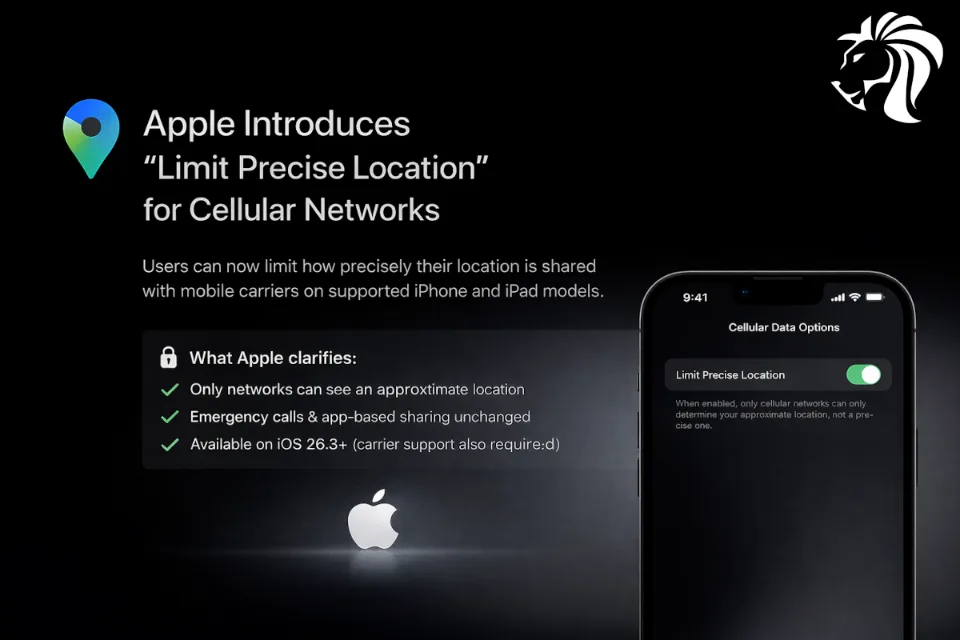
Apple is rolling out a new privacy feature that allows users to limit how precisely their location is shared with mobile carriers on supported iPhone and iPad models.
With iOS 26.3 and later, users can enable “Limit Precise Location”, ensuring that cellular networks can only see an approximate location (e.g., neighborhood level) instead of a precise street address when determining device position via cell towers.
🔐 What Apple clarifies:
- 🚨 Emergency calls are not affected
- 📍 App-based location sharing (Find My, Location Services) remains unchanged
- 📡 Only cellular network visibility is limited
📲 How to enable it:
Settings → Cellular → Cellular Data Options → Limit Precise Location
The feature currently works on:
- iPhone Air
- iPhone 16e
- iPad Pro (M5) Wi-Fi + Cellular
(running iOS 26.3+)
🌍 Carrier support is limited for now, including networks in:
- 🇩🇪 Germany (Telekom)
- 🇬🇧 UK (EE, BT)
- 🇺🇸 US (Boost Mobile)
- 🇹🇭 Thailand (AIS, True)
The move follows major regulatory scrutiny, including nearly $200M in FCC fines issued to major U.S. carriers in 2024 for mishandling location data.
🎯 Apple’s latest change is a meaningful step toward reducing passive location tracking by telecom providers — even if availability is currently limited.
What this means for telecom operators
- 📍 Reduced visibility into precise subscriber location may impact analytics, fraud detection, and network optimization workflows.
- 📜 Greater regulatory pressure: Apple’s move aligns with tighter global scrutiny (FCC, GDPR-style principles), pushing carriers to justify and minimize location data collection.
- 🔧 Network compatibility requirements: Support for “Limit Precise Location” will likely become a competitive differentiator, forcing carriers to update signaling and policy controls.
Bigger picture
🛡️ Apple is shifting the balance of power — location data is no longer assumed to be infrastructure metadata, but rather user-controlled personal data. Enterprises and carriers should expect this model to expand.


