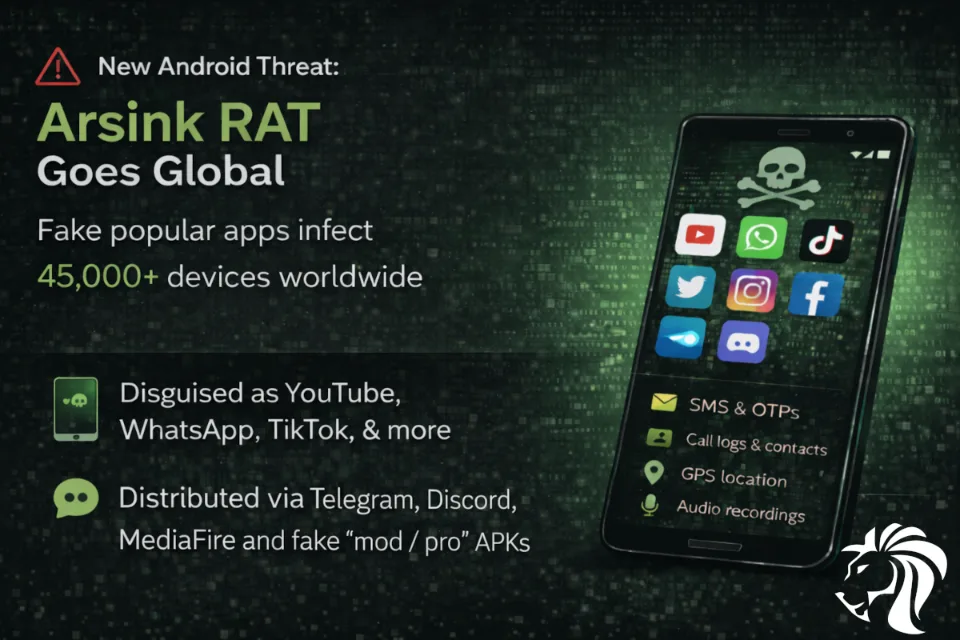
New Android Threat: Arsink RAT Goes Global

A dangerous Android Remote Access Trojan (RAT) called Arsink is actively infecting mobile devices worldwide, giving attackers full control over phones while silently stealing sensitive data.

Security News 1 min read

New Android Threat: Arsink RAT Goes Global

A dangerous Android Remote Access Trojan (RAT) called Arsink is actively infecting mobile devices worldwide, giving attackers full control over phones while silently stealing sensitive data.

How Arsink Spreads

📱 Disguised as popular apps (YouTube, WhatsApp, Instagram, TikTok, Facebook)
💬 Distributed via Telegram, Discord, MediaFire, and fake “mod / pro” APKs
🔐 Abuses excessive permissions with no real app functionality

Scale of the Threat

📊 ~45,000 infected devices
🌐 Victims across 143 countries
🔥 Highest impact: Egypt, Indonesia, Iraq, Yemen, South Asia

What the Malware Steals

📩 SMS & one-time passwords (OTP)
📞 Call logs & contacts
📍 Real-time location data
🎙️ Microphone audio recordings

Advanced Capabilities

☁️ Cloud-native C2 via Firebase, Telegram bots, Google Drive
👻 Hides its app icon & runs persistent foreground services
🛠️ Remote actions: calls, file uploads, flashlight control, data wiping

Mobile malware is no longer opportunistic — it’s industrial-scale, cloud-driven, and stealthy.


Why This Matters

📌 Social engineering remains the primary infection vector
📌 Cloud services are being abused to evade detection
📌 Mobile devices are now high-value surveillance targets

Blog

Microsoft 5 min read

Keys, Tenants and Trust: two Microsoft cloud incidents that call for action this week

Two Microsoft cloud services were hit in November 2026, and each needs a different response. In Azure API Management (APIM) Classic, attackers exploited a flaw to steal stored secrets, and Norway's security agency says those secrets should be treated as exposed. In Entra Connect Health, attackers accessed tenant metadata and administrator email addresses, but Microsoft says passwords and authentication tokens were not exposed.

Security 5 min read

Ransomware group lists Nvidia on its leak site, but offers no proof

On 18 November 2026, the ransomware group The Gentlemen added Nvidia to its dark web leak site and set a countdown to 28 November. The listing contains no sample files, screenshots or data inventory. Nvidia says it is investigating an incident that may have affected a third-party partner, and that it has found no indication that its own systems or networks were affected. The claim is unverified.

Security 4 min read

Patch Splunk, and retire any internet-facing SonicWall Gen 6 firewall

On 18 November 2026, Splunk patched nearly 140 vulnerabilities in Enterprise, Enterprise Security and SOAR, including several critical flaws, with no active exploitation reported. SonicWall told customers to retire Gen 6 firewalls from the internet edge, as they no longer receive patches for any severity. Patch Splunk and replace Gen 6 devices.