
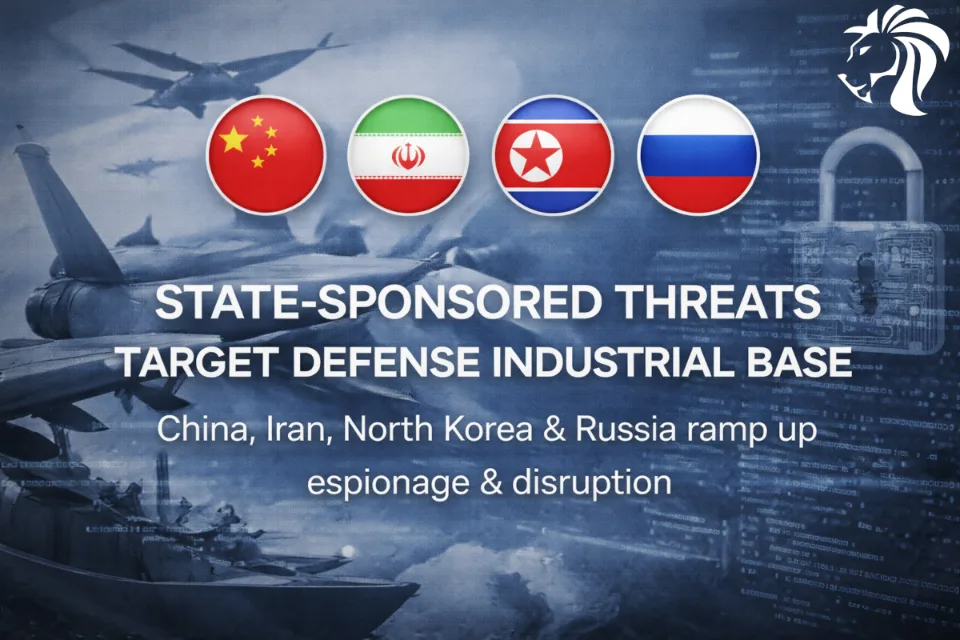
Defense Industrial Base Under Constant Cyber Siege

Google Threat Intelligence Group (GTIG) reports that state-sponsored actors from China, Iran, North Korea, and Russia are aggressively targeting the Defense Industrial Base (DIB).

Security News 2 min read

Defense Industrial Base Under Constant Cyber Siege

Google Threat Intelligence Group (GTIG) reports that state-sponsored actors from China, Iran, North Korea, and Russia are aggressively targeting the Defense Industrial Base (DIB).

🎯 Four dominant attack themes:

1️⃣ Targeting battlefield technologies (drones, autonomous systems, secure comms) linked to the Russia–Ukraine war
2️⃣ Direct targeting of employees via recruitment lures & job process exploitation
3️⃣ Exploiting edge devices & appliances for initial access
4️⃣ Supply-chain intrusions in manufacturing environments

⚙️ Notable Tactics Observed

• Signal & Telegram abuse (device linking hijacks, data exfiltration)
• Android malware targeting drone operators and battlefield apps
• Malicious RDP files, LNK payloads, and loader chains
• Dream Job–style recruitment phishing campaigns
• ORB (Operational Relay Box) networks for stealth reconnaissance
• Targeted reconnaissance against military login portals

📡 Adversaries are increasingly focused on:

  • Drones & autonomous systems
  • Battlefield management platforms
  • Secure messaging tools
  • Aerospace & defense contractors
  • Manufacturing supply chains

⚠️ GTIG’s assessment is clear:
The defense industrial base is facing persistent, multi-vector pressure — from espionage to disruption to financially motivated extortion.

This is not opportunistic noise. It is sustained strategic targeting.


What This Means for Defense & Manufacturing

• Assume targeted reconnaissance is already happening
• Secure edge devices & messaging platforms as priority assets
• Harden recruitment & HR workflows against infiltration
• Monitor for supply-chain compromise indicators
• Expect adversaries to avoid traditional EDR detection


Blog

Microsoft 5 min read

Keys, Tenants and Trust: two Microsoft cloud incidents that call for action this week

Two Microsoft cloud services were hit in November 2026, and each needs a different response. In Azure API Management (APIM) Classic, attackers exploited a flaw to steal stored secrets, and Norway's security agency says those secrets should be treated as exposed. In Entra Connect Health, attackers accessed tenant metadata and administrator email addresses, but Microsoft says passwords and authentication tokens were not exposed.

Security 5 min read

Ransomware group lists Nvidia on its leak site, but offers no proof

On 18 November 2026, the ransomware group The Gentlemen added Nvidia to its dark web leak site and set a countdown to 28 November. The listing contains no sample files, screenshots or data inventory. Nvidia says it is investigating an incident that may have affected a third-party partner, and that it has found no indication that its own systems or networks were affected. The claim is unverified.

Security 4 min read

Patch Splunk, and retire any internet-facing SonicWall Gen 6 firewall

On 18 November 2026, Splunk patched nearly 140 vulnerabilities in Enterprise, Enterprise Security and SOAR, including several critical flaws, with no active exploitation reported. SonicWall told customers to retire Gen 6 firewalls from the internet edge, as they no longer receive patches for any severity. Patch Splunk and replace Gen 6 devices.
