
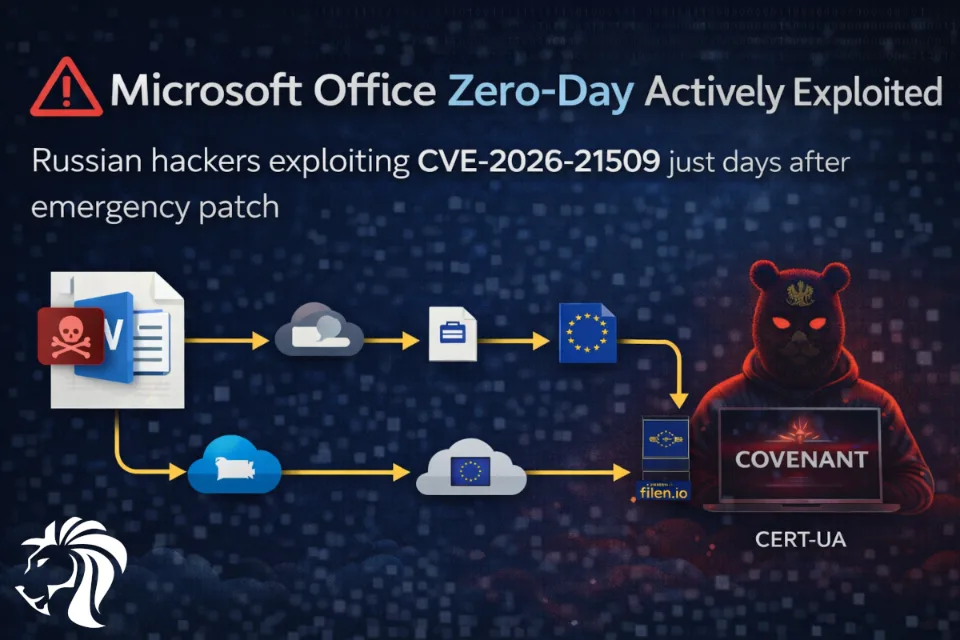
Active Exploitation of Microsoft Office Zero-Day

Ukraine’s CERT-UA has confirmed active exploitation of CVE-2026-21509, a recently patched zero-day vulnerability affecting multiple versions of Microsoft Office.

Security News 1 min read

Active Exploitation of Microsoft Office Zero-Day

Ukraine’s CERT-UA has confirmed active exploitation of CVE-2026-21509, a recently patched zero-day vulnerability affecting multiple versions of Microsoft Office.

🗓️ Microsoft released an emergency out-of-band update on January 26, marking the flaw as actively exploited. Just days later, CERT-UA detected malicious DOC files abusing the vulnerability in targeted phishing campaigns.

🎯 Observed lures & targeting

  • EU COREPER consultation themes related to Ukraine
  • Emails impersonating the Ukrainian Hydrometeorological Center
  • Over 60 government-related recipients targeted

🕵️ Attribution
CERT-UA attributes the activity to APT28 (aka Fancy Bear / Sofacy), a Russian state-linked threat actor associated with the GRU.

🧬 Attack chain overview

  • Malicious DOC triggers a WebDAV download chain
  • COM hijacking loads a rogue DLL (EhStoreShell.dll)
  • Shellcode hidden in an image file (SplashScreen.png)
  • Persistence via a scheduled task (OneDriveHealth)
  • Final payload: COVENANT malware framework

☁️ C2 infrastructure
COVENANT communicates via filen.io cloud storage — a notable detection and blocking opportunity.

🌍 Wider impact
Subsequent attacks using similar documents were observed against EU-based organizations, confirming the campaign extends beyond Ukraine.

🛡️ Defensive actions

  • Apply the latest Microsoft Office updates immediately
  • Ensure Office apps are restarted to activate protections
  • If patching isn’t possible, apply registry-based mitigations
  • Enforce Protected View for internet-origin documents
  • Monitor or block suspicious filen.io connections

Blog

Microsoft 5 min read

Keys, Tenants and Trust: two Microsoft cloud incidents that call for action this week

Two Microsoft cloud services were hit in November 2026, and each needs a different response. In Azure API Management (APIM) Classic, attackers exploited a flaw to steal stored secrets, and Norway's security agency says those secrets should be treated as exposed. In Entra Connect Health, attackers accessed tenant metadata and administrator email addresses, but Microsoft says passwords and authentication tokens were not exposed.

Security 5 min read

Ransomware group lists Nvidia on its leak site, but offers no proof

On 18 November 2026, the ransomware group The Gentlemen added Nvidia to its dark web leak site and set a countdown to 28 November. The listing contains no sample files, screenshots or data inventory. Nvidia says it is investigating an incident that may have affected a third-party partner, and that it has found no indication that its own systems or networks were affected. The claim is unverified.

Security 4 min read

Patch Splunk, and retire any internet-facing SonicWall Gen 6 firewall

On 18 November 2026, Splunk patched nearly 140 vulnerabilities in Enterprise, Enterprise Security and SOAR, including several critical flaws, with no active exploitation reported. SonicWall told customers to retire Gen 6 firewalls from the internet edge, as they no longer receive patches for any severity. Patch Splunk and replace Gen 6 devices.

