
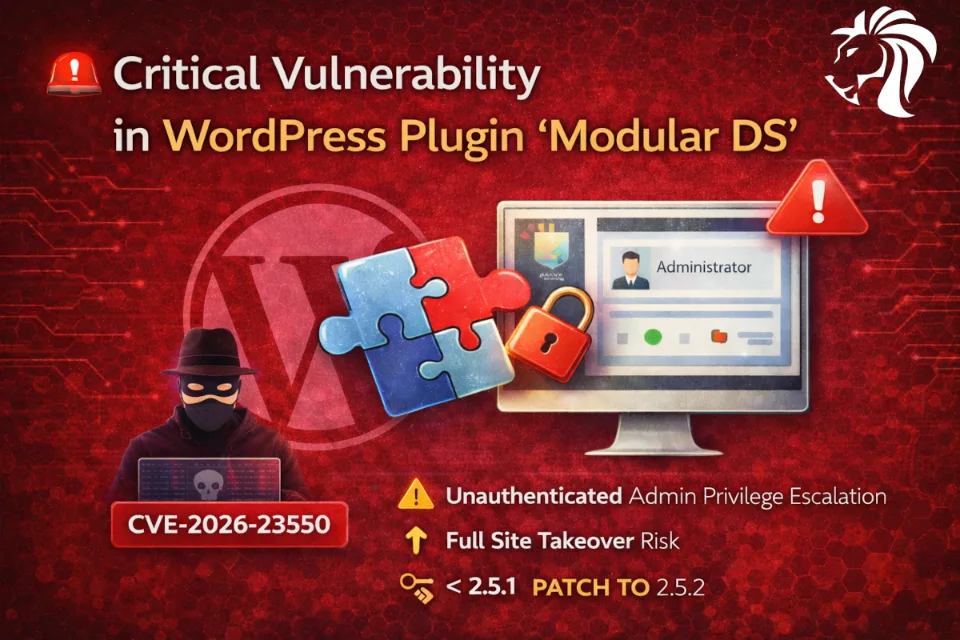
Active Exploitation: Critical WordPress Plugin Vulnerability (CVSS 10.0)

Patchstack has confirmed the active exploitation of a maximum-severity vulnerability in the Modular DS WordPress plugin, affecting over 40,000 sites.

Security News 2 min read

Active Exploitation: Critical WordPress Plugin Vulnerability (CVSS 10.0)

Patchstack has confirmed the active exploitation of a maximum-severity vulnerability in the Modular DS WordPress plugin, affecting over 40,000 sites.

🔓 CVE-2026-23550 allows unauthenticated privilege escalation, enabling attackers to auto-login as administrators and fully compromise affected websites.

What’s the issue?

The flaw stems from overly permissive routing logic in the plugin’s /api/modular-connector/ endpoints.

Attackers can bypass authentication when:

  • direct request mode is enabled
  • Requests include crafted parameters such as: origin=mo&type=xxx

This causes protected routes to be treated as trusted internal requests — without cryptographic verification.

Exposed functionality includes:

  • /login/ → auto-admin access
  • /server-information/
  • /manager/
  • /backup/

Once exploited, attackers can:

  • Create new admin users
  • Exfiltrate sensitive data
  • Inject malware or backdoors
  • Redirect visitors to scams

Exploitation timeline

📅 First detected: January 13, 2026 (02:00 UTC)
🌍 Observed attacker IPs:

  • 45.11.89.19
  • 185.196.0.11

Mitigation & Response

✅ Update immediately to Modular DS 2.5.2
🔍 Review your site for:

  • Unexpected admin accounts
  • Suspicious login attempts

If compromise is suspected:

  • Regenerate WordPress salts
  • Rotate OAuth credentials
  • Scan for malicious plugins/files

🗣️ “This vulnerability shows how dangerous implicit trust in internal request paths can be when exposed to the public internet.” — Patchstack

Key Takeaway

This wasn’t a single bug — it was a chain of risky design decisions:

  • URL-based route matching
  • Trusting the connection state instead of the request identity
  • Auto-fallback admin login logic

A textbook example of how design flaws + exposed APIs = critical risk.

Blog

Microsoft 5 min read

Keys, Tenants and Trust: two Microsoft cloud incidents that call for action this week

Two Microsoft cloud services were hit in November 2026, and each needs a different response. In Azure API Management (APIM) Classic, attackers exploited a flaw to steal stored secrets, and Norway's security agency says those secrets should be treated as exposed. In Entra Connect Health, attackers accessed tenant metadata and administrator email addresses, but Microsoft says passwords and authentication tokens were not exposed.

Security 5 min read

Ransomware group lists Nvidia on its leak site, but offers no proof

On 18 November 2026, the ransomware group The Gentlemen added Nvidia to its dark web leak site and set a countdown to 28 November. The listing contains no sample files, screenshots or data inventory. Nvidia says it is investigating an incident that may have affected a third-party partner, and that it has found no indication that its own systems or networks were affected. The claim is unverified.

Security 4 min read

Patch Splunk, and retire any internet-facing SonicWall Gen 6 firewall

On 18 November 2026, Splunk patched nearly 140 vulnerabilities in Enterprise, Enterprise Security and SOAR, including several critical flaws, with no active exploitation reported. SonicWall told customers to retire Gen 6 firewalls from the internet edge, as they no longer receive patches for any severity. Patch Splunk and replace Gen 6 devices.

