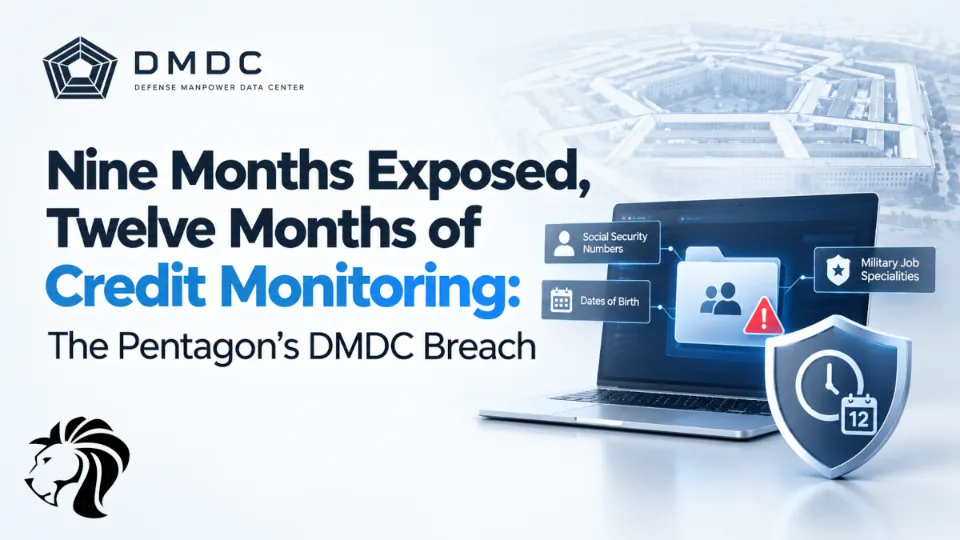
The Defense Manpower Data Center (DMDC), the US Department of Defense's central personnel and identity clearinghouse, has confirmed a breach of one of its file-sharing systems.
The numbers, confirmed by a defence official to CNN: 2.76 million living individuals and 294,000 deceased, just over three million people in total.
The timeline is the part that matters most. The vulnerability allowed unauthorised access from around October 2025 until 16 July 2026, when it was discovered. That is roughly nine months. Notification letters to victims were dated 18 September 2026, a further two months later.
The exposed files were unencrypted and included Social Security numbers.
On the week of 20 October, two Marines filed a federal class action against the department. The Pentagon has said it has seen no evidence the data has been misused.
What happened
The timeline
When | What |
|---|---|
Around October 2025 | Unauthorised access to a DMDC file-sharing system begins |
16 July 2026 | DMDC discovers the vulnerability, roughly nine months later |
18 September 2026 | Notification letters to affected individuals are dated |
Late September 2026 | Breach becomes public through Military Times and subsequent reporting |
Week of 20 October 2026 | Two Marines file a federal class action |
What was exposed
Exposed records varied by individual, and included combinations of:
Social Security numbers
Full names and dates of birth
Contact details
Demographic data including sex and race
Military personnel data, including military occupational specialities
The files were held unencrypted. DMDC's notice describes access by a "small number of unauthorized users".
What DMDC is
This is not a peripheral system. DMDC is the Pentagon's main personnel-data and identity clearinghouse, maintaining more than 60 million person records as of fiscal year 2024, covering military personnel, civilian employees, contractors, family members, retirees and veterans. Other Defense Department systems depend on its data to verify military service, benefits eligibility and ID cards.
Roughly one in twenty of the records it holds were exposed. For context, the US military currently has about 1.36 million active-duty members, so the affected population is more than twice that figure.
DMDC also houses the Defense Casualty Analysis System.
The lawsuit
Active-duty Marine Tristyn Edwards and Marine veteran Morgan Stampfli filed a federal class action naming the department as defendant. The complaint alleges the Pentagon showed "flagrant disregard for the privacy interests of service members" and failed to implement the administrative, technical and physical safeguards required by the Privacy Act.
Edwards argues the harm will continue for years, citing identity theft, fraudulent charges and credit lines opened without permission. The plaintiffs seek to represent more than three million affected individuals and are seeking more than $5 million in damages.
What has not been established
Several things are being asserted online that the reporting does not support:
No foreign government has been shown to have obtained the records. There is no established finding to that effect.
No attribution has been published. The "small number of unauthorized users" has not been identified publicly.
The Pentagon says it has detected no misuse. That is a statement about detection, not about what happened.
The surrounding context
The FBI suffered a significant breach around the same period, reportedly at the hands of the cybercrime group ShinyHunters, exposing records of personnel in intelligence roles. These are separate incidents, but they bear on the same question: how well US federal agencies are protecting the personal data of people whose identities are themselves sensitive.
The precedent everyone reaches for is the 2015 Office of Personnel Management breach, which exposed roughly 21.5 million background-investigation records and separately affected about 4.2 million federal employees. That one included fingerprints and personal-history data. It is larger, and it is the reason this category of breach is treated as a counterintelligence matter rather than a privacy matter.
Why it matters
The combination of fields is the problem, not any single one. A Social Security number is a fraud risk. A Social Security number paired with a military occupational speciality, date of birth and contact details is a targeting package. It tells an adversary not just who someone is, but what they do, which makes it possible to sort three million people by usefulness.
"No evidence of misuse" means less here than usual. A foreign intelligence service that obtains this data does not open credit cards with it. It builds profiles, identifies approachable individuals, and constructs convincing contact. One security assessment quoted in reporting described the risk as enabling "phishing, profiling, foreign intel approaches, and much more". None of that generates the kind of signal a credit monitoring service detects.
Twelve months of credit monitoring does not match the risk. The Pentagon has offered a year of identity protection and credit monitoring. Social Security numbers cannot be changed easily. A person's military service history never changes. Stolen identity data of this kind stays useful for years and can be combined with public records, commercial databases, social networks and earlier breaches to build highly tailored campaigns. The remedy expires. The exposure does not.
Eleven months passed between the start of exposure and notification. Nine months undetected, then two more before letters went out. For affected individuals, that is eleven months during which they could not take even basic protective steps.
Unencrypted is the word that will define this case. Encryption at rest would not have prevented unauthorised access to the server, but it would have changed what the intruders walked away with. In litigation under the Privacy Act, that distinction will matter.
Who is affected
2.76 million living individuals with military ties, spanning serving personnel, civilian employees, contractors, retirees, veterans and family members.
The families of 294,000 deceased individuals, who are generally not covered by identity protection offers and have no straightforward route to redress.
Active-duty personnel in sensitive roles, for whom the exposure of occupational speciality is the most consequential field.
Anyone whose spouse or parent is in the affected population, since family members are in DMDC's records and relationship data assists targeting.
The Department of Defense itself, facing class action litigation and renewed scrutiny of how it secures personnel data.
What to do if you may be affected
Immediately
Check whether you received a notification letter dated 18 September 2026. If you have moved, the letter may not have reached you.
Enrol in the offered identity protection and credit monitoring, while understanding that twelve months is shorter than the risk period.
Place a credit freeze with the major bureaus. A freeze is more protective than monitoring, because monitoring tells you after something happened and a freeze prevents it.
Set up fraud alerts and consider renewing them when they expire.
Because the risk is not only financial
Expect targeted social engineering, not just fraud. Messages that correctly reference your service, your unit or your job speciality are now possible to construct. Treat accurate personal detail as no evidence of legitimacy.
Be cautious about unsolicited professional approaches, including recruitment offers, research requests and conference invitations, particularly where the approach demonstrates knowledge of your role.
Report suspicious contact through your chain of command or security office, not only to consumer fraud services. If the approach is intelligence-related, consumer agencies are the wrong recipient.
Review what else about you is public, including social media that confirms service details, since the value of the breached data increases when it can be corroborated.
For organisations holding similar data
Encrypt personnel data at rest. This is the single technical control that would have changed the outcome.
Audit file-sharing systems specifically. They tend to sit outside the main application security programme and accumulate sensitive extracts.
Measure your detection time for unauthorised access to data stores. Nine months is the figure to compare yourself against.
Shorten the gap between discovery and notification. Two months is time that victims could have spent protecting themselves.
Match the remedy to the data. Where exposed data cannot be changed, a time-limited monitoring offer is a gesture rather than a fix.
Final thoughts
A file-sharing server, a vulnerability nobody noticed for nine months, and three million unencrypted records belonging to people whose employer is the United States military. The Pentagon's response, that no misuse has been detected and a year of credit monitoring is available, is the standard corporate playbook for a consumer data breach.
The lesson: the remedy has to match the nature of the data, and here it does not. Credit monitoring is built to detect financial fraud quickly. The serious risk from this breach is that a foreign service now holds a sortable list of three million military-connected people with their job specialities attached, which is a counterintelligence problem that produces no credit-bureau alerts and no expiry date. Nothing about the response addresses that, because there is no consumer product that can.
The second lesson is narrower and applies to every organisation holding personnel records. The intruders got into a file-sharing system, which is exactly the kind of infrastructure that sits between teams, accumulates exports and extracts, and belongs to nobody in particular. It is rarely in scope for application security review, rarely encrypted by default, and routinely holds the most sensitive data in the organisation because somebody needed to send it somewhere.
Two questions worth asking: what is sitting on your file-sharing systems right now, and would you notice if someone had been reading it since last autumn?