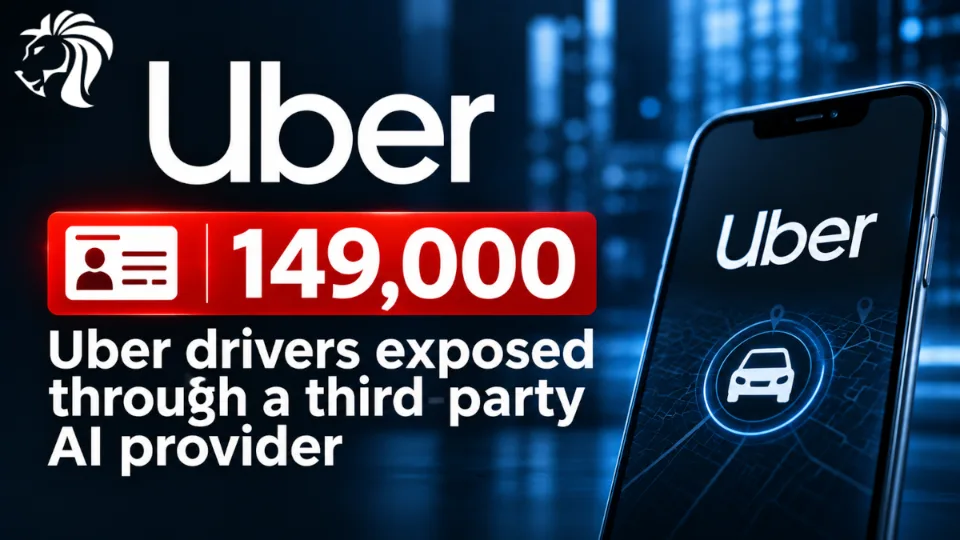
Uber shares data with third-party service providers so that they can perform work on its behalf. In this case, the provider was Fireworks AI. Uber did not name the provider in its breach notifications, but a company spokesperson confirmed the link to Fireworks AI.
The timeline, as Uber reported it, runs as follows:
Date | Event |
|---|---|
7 October 2026 | Attackers use compromised service provider credentials to access data Uber had shared with the provider |
9 October 2026 | Uber learns of the incident and cuts its data connections with the provider |
13 October 2026 | Uber's investigation determines what data was accessed |
9 to 10 November 2026 | Uber updates its disclosure and files breach notifications with US state authorities |
Uber has said the compromised credentials did not give access to its other systems. The company has filed breach notifications in California, Iowa, Massachusetts, South Carolina, Texas and Vermont, and has offered affected drivers free credit monitoring and fraud assistance.
What was taken
According to Uber's notifications, the stolen information includes:
names and addresses
dates of birth
driver's licence numbers
other government-issued identification numbers
images of driver's licences
In a November update, Uber said the breach also affected account and billing information, some customer datasets and incomplete AI models. Reports on the full scope of these additional categories differ, and Uber has not published a complete list, so this article treats them as reported rather than confirmed.
Uber has said it has not identified any misuse of the data. Notifying drivers before any misuse is found is a deliberate choice, because stolen identity documents are often used long after a breach.
Why this matters for drivers
Driver's licence numbers and dates of birth are valuable to criminals because they are hard to change. A password can be reset, but a licence number remains the same. Combined with a name, address and date of birth, this information can support identity fraud, such as opening accounts or applying for credit in someone else's name.
Images of licences are a particular concern, because they can be used to create fake documents that pass basic checks. Drivers should expect targeted phishing emails and phone calls that refer to Uber, the breach or their licence details.
Why it matters for organisations
The attacker did not break into Uber's own systems, according to Uber. They used credentials belonging to a provider, which then gave access to data Uber had shared. This pattern is common in supply-chain incidents: a company can have strong defences but still lose data held by its suppliers.
Uber's own filings show that it has been aware of this risk for some time. Its annual reports describe third-party providers as a source of security exposure, and the company has previously faced a large breach. A 2016 incident exposed data from about 57 million drivers and consumers, including the licence numbers of about 600,000 drivers, and led to a regulatory order from the US Federal Trade Commission in 2023.
The lesson for other organisations is practical: sharing data with a provider is a security decision, not only a contractual one. Each provider holding sensitive personal data should be treated as an extension of your own attack surface.
What drivers should do
Watch for unexpected messages that mention Uber, a breach, a licence or a government agency. Do not click links or give information over the phone unless you contacted the organisation yourself.
Enrol in the credit monitoring that Uber offers, using the link or number in the official notice.
Check your credit report regularly, and consider a fraud alert or credit freeze, which are available in many jurisdictions at no cost.
Consider replacing your licence if you are worried about the number's misuse, and ask your licensing authority what options exist.
Use strong, unique passwords and enable multi-factor authentication on accounts linked to your email address.
What organisations should do
Companies that share personal data with suppliers should verify that each supplier restricts credentials to the minimum access needed, enforces multi-factor authentication, and monitors for unusual access. Contracts should set clear expectations for breach notification, and organisations should be able to cut off a provider's data access quickly, as Uber did.
Data minimisation matters too. Sharing only the fields a provider needs reduces the damage when a supplier is compromised. Storing identity document images with a third party is a higher-risk choice that should be justified.
The lesson
The Uber case shows that a single compromised set of supplier credentials can expose sensitive identity data for many people at once. Uber acted quickly once it learned of the breach, but the data was already gone, and the drivers affected will carry the risk for years.
The question for any organisation is not only whether its own systems are secure, but whether every provider holding its data would contain a breach as quickly as Uber did.